
1) Robotis Quietly Turns Robotics Hype Into Real Profits
A rare sign of maturity in the robotics sector | Weekly Robotics News | The Bolt and the Byte
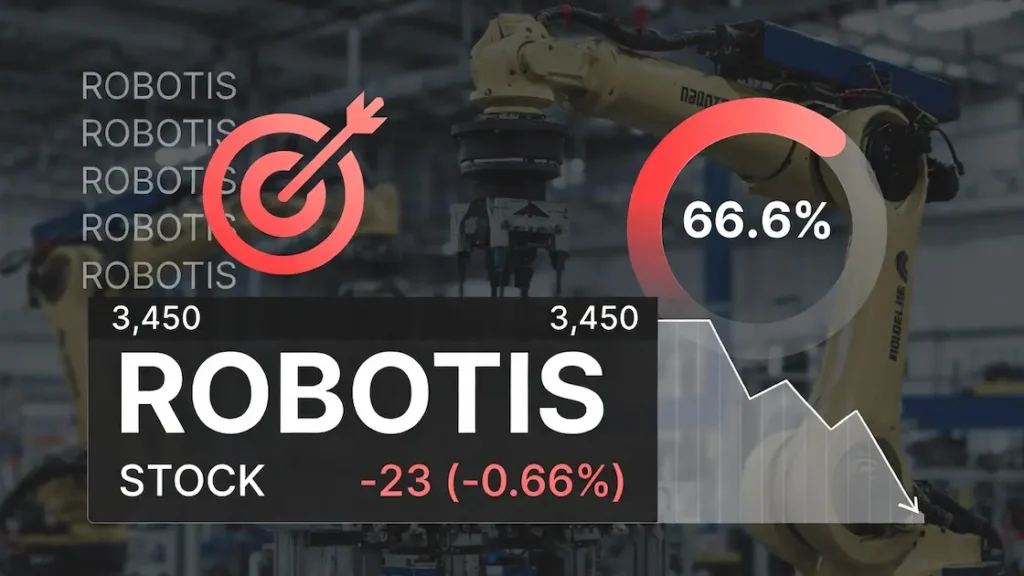
For years, Robotis has been known as a respected robotics hardware company, but rarely as a profitable one. That narrative shifted this week as new financial data showed meaningful improvement in its core robotics business, triggering renewed investor interest.
What stands out is where the growth is coming from. Rather than speculative AI experiments, Robotis is benefiting from steady demand for actuators, motion systems, and robotics platforms used in education, research, and early industrial deployments. These are the unglamorous building blocks of robotics — but they pay the bills.
Why this matters is simple: robotics companies that prove sustainable revenue models set the tone for the entire sector. In a market crowded with promises, Robotis is showing that slow, hardware-driven progress can still win.
Key points
- Growth driven by core robotics products, not hype
- Signals financial stability in a volatile robotics market
- Encourages long-term investment in hardware-focused firms
2) Robotis’ “AI Worker” Humanoid Signals a Shift From Demos to Deployment
Tokyo expo reveals where humanoid robotics is heading | Weekly Robotics News | The Bolt and the Byte
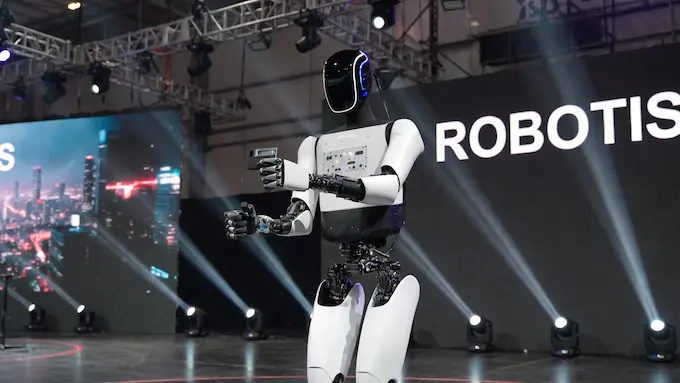
At Japan’s iREX robotics exhibition, Robotis unveiled its latest humanoid platform, “AI Worker.” Unlike theatrical humanoid demos designed to impress crowds, this robot was framed as a worker — a system meant to perform repeatable physical tasks.
The company emphasized integration of perception, balance, and task execution rather than flashy human-like behavior. This reflects a growing industry realization: humanoids won’t succeed by mimicking people, but by doing jobs humans don’t want to do.
The demonstration matters because it reframes humanoids as tools, not novelties. If this approach sticks, humanoid robots may finally find their way into controlled industrial environments first — before expanding outward.
Key points
- Focus on utility, not entertainment
- Designed for logistics and structured workplaces
- Signals maturation of humanoid design philosophy
3) LG and Robotis Bet on Humanoids as a Business, Not a Experiment
Korea’s consumer tech giant moves deeper into robotics | Weekly Robotics News | The Bolt and the Byte
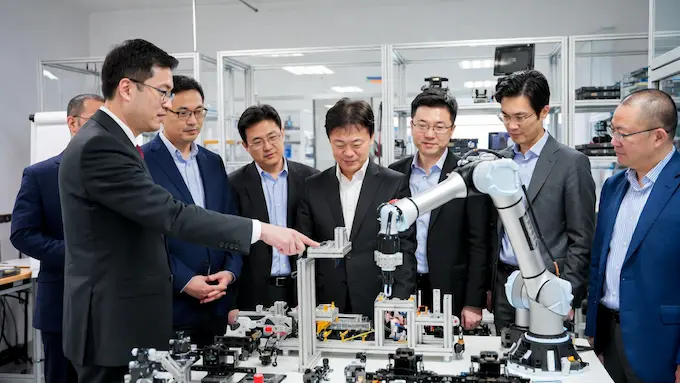
LG Electronics’ partnership with Robotis marks a notable shift in how large electronics companies view robotics. This isn’t a research sponsorship — it’s a strategic move into physical AI systems that could one day sit alongside LG’s commercial offerings.
LG brings global distribution, system integration, and manufacturing experience. Robotis brings years of robotics hardware expertise. Together, they are targeting humanoid robots that could realistically be deployed, serviced, and scaled.
This matters because big consumer electronics companies don’t invest lightly. LG’s involvement suggests humanoid robotics is no longer seen as science fiction, but as a potential commercial category.
4) Robotis and Tomorrow Robotics Focus on “Physical AI”
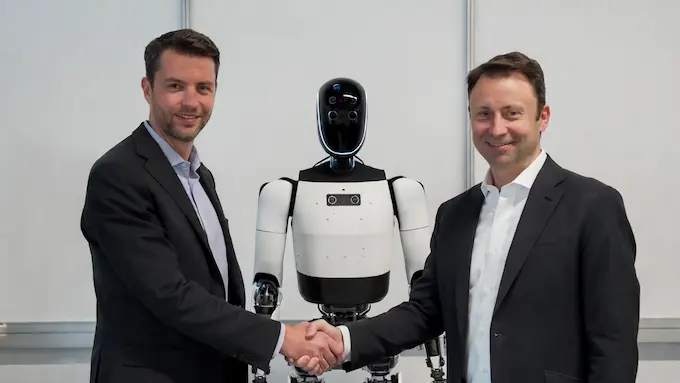
Teaching robots how to act, not just think | Weekly Robotics News | The Bolt and the Byte
In another partnership, Robotis joined forces with Tomorrow Robotics to develop robots powered by what both companies call “physical AI.” This concept centers on robots learning how to interact with the real world — balancing, gripping, adapting — rather than simply processing data.
Most AI today lives in software. Physical AI is harder, slower, and more expensive. But it’s also what separates useful robots from impressive demos.
The partnership signals a long-term bet: the future of robotics won’t be won by software alone. It will be won by machines that understand physics, uncertainty, and failure.
5) Korean Robotics Stocks Rise as Investors Reprice Reality

Capital flows toward companies that actually build robots | Weekly Robotics News | The Bolt and the Byte
Recent movements in Korean markets show robotics and AI stocks outperforming broader indices. This isn’t driven by viral headlines, but by reassessment of which companies are positioned to survive the next decade.
Investors appear to be favoring firms with manufacturing capabilities, real customers, and hardware-software integration — a sharp contrast to earlier speculative waves.
For the robotics sector, this shift matters. Capital allocation shapes which technologies get built — and which quietly disappear.
6) Leaders at COMEUP 2025 Admit Robotics Is Harder Than AI
Why “physical AI” is the industry’s toughest challenge | Weekly Robotics News | The Bolt and the Byte
At the COMEUP 2025 conference, robotics leaders spoke candidly about the limits of current AI when applied to physical machines. Unlike software, robots must deal with gravity, friction, and unpredictable environments.
Speakers emphasized that progress in robotics will be slower than in generative AI — but more durable. Success depends on data collected from real-world operation, not synthetic simulations alone.
This honesty matters. It tempers expectations while reinforcing why robotics remains one of the hardest engineering problems of our time.
7) Uzbekistan Enters the Global Robotics Race
An unexpected player bets on humanoids | Weekly Robotics News | The Bolt and the Byte
Uzbekistan’s agreement with Robotis surprised many observers. The country is positioning itself not just as a buyer of robotics technology, but as a future producer.
The plan includes local manufacturing, workforce training, and long-term infrastructure investment. For Robotis, it offers expansion beyond saturated markets. For Uzbekistan, it’s a leap into high-value manufacturing.
This story matters because robotics production is slowly decentralizing. New regions want in — and established firms are listening.
8) From Agreements to Action in Uzbekistan
Robotics cooperation moves beyond paper | Weekly Robotics News | The Bolt and the Byte
Follow-up meetings between Uzeltekhsanoat and Robotis show that Uzbekistan’s ambitions aren’t symbolic. Discussions now focus on implementation: where robots will be used, how technicians will be trained, and how local industry adapts.
Many robotics partnerships fail at this stage. Execution is harder than signing agreements. That’s why this step is important.
If successful, it could become a blueprint for other emerging economies entering robotics manufacturing.
9) A Planned Humanoid Robot Factory Signals Serious Intent
66,000 square meters dedicated to robotics | Weekly Robotics News | The Bolt and the Byte
Plans for a large-scale humanoid robot production facility in Uzbekistan underscore how serious the country’s ambitions are. This is not a pilot lab — it’s an industrial-scale commitment.
Incentives, infrastructure, and long-term planning suggest officials see robotics as a strategic industry, not a side project.
The move matters because humanoid production requires supply chains, skilled labor, and long-term demand — all signs of confidence.
10) Seoul Doubles Down on Robotics R&D
Public funding fuels private innovation | Weekly Robotics News | The Bolt and the Byte
Seoul’s investment in over 150 AI and robotics projects highlights how cities, not just nations, are becoming innovation engines.
By pairing funding with events like the Seoul AI Robot Show, the city is creating an ecosystem — not just isolated research grants.
This approach matters because robotics thrives where talent, capital, and testing environments coexist.
11) South Korea Sets a Timeline for Humanoid Production
2029 is closer than it sounds | Weekly Robotics News | The Bolt and the Byte
South Korea’s national plan to mass-produce humanoid robots by 2029 is ambitious — and intentionally public. By setting a date, the government is forcing coordination between manufacturers, suppliers, and regulators.
Whether the timeline holds matters less than the signal it sends: humanoids are no longer “someday” technology.
12) The Hidden Reality: Most Robot Companies Are Small and Fragile
Innovation doesn’t always mean stability | Weekly Robotics News | The Bolt and the Byte
Nearly all Korean robotics companies are small or mid-sized firms struggling with financing. This contrasts sharply with the futuristic image of the industry.
Hardware development is expensive, slow, and unforgiving. Without sustained capital, many promising ideas never leave the lab.
This matters because the health of robotics depends on supporting these smaller builders — not just celebrating giants.
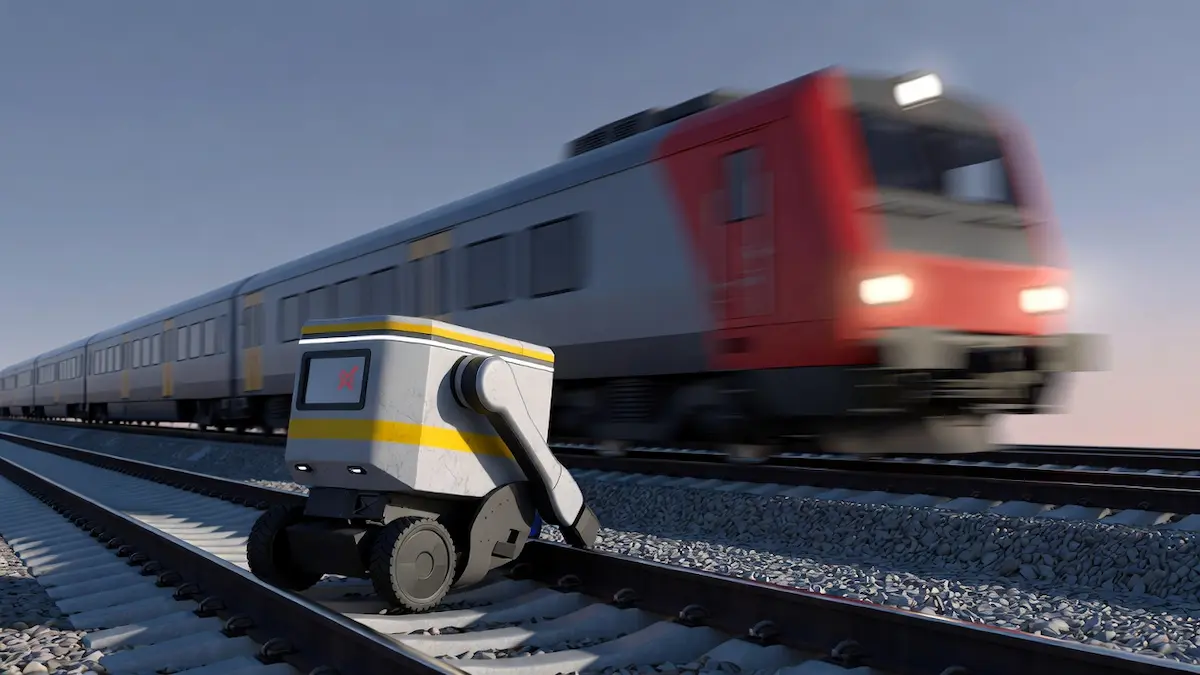
13) A Delivery Robot Meets a Train — and Reality
Why autonomy still fails in the real world | Weekly Robotics News | The Bolt and the Byte
A delivery robot was destroyed after becoming stuck on railway tracks and being hit by a train. The incident is dramatic — but not unusual.
Urban environments are chaotic. Sensors fail. Edge cases appear. This story highlights the gap between controlled testing and real-world deployment.
It matters because safety, accountability, and infrastructure coordination remain unresolved in last-mile robotics.
14) Yarbo Proves Home Robots Can Actually Work
Autonomous snow removal without human babysitting | Weekly Robotics News | The Bolt and the Byte
During a severe winter storm, the Yarbo robot autonomously cleared a large driveway while its owner stayed indoors. No remote control. No intervention.
This matters because it shows consumer robots crossing a threshold: from novelty to utility.
Yarbo isn’t cheap — but it works. And working robots change behavior.
15) Home Robots Are Quietly Expanding Their Role
From snow to year-round autonomy | Weekly Robotics News | The Bolt and the Byte
Beyond snow clearing, Yarbo’s modular design points to a future where home robots handle multiple outdoor tasks across seasons.
The technology isn’t revolutionary — GPS, sensors, autonomy — but the integration is what counts.
This story matters because it hints at how robotics may enter everyday life: not dramatically, but gradually.
Weekly Robotics News – FAQs
Q: Why do robotics navigation failures still happen?
A: Delivery bots and other autonomous machines depend on sensors and algorithms that can fail in unexpected environments like train tracks, contributing to accidents.
Q: How soon could home robots like Yarbo become common?
A: They’re commercially available now but require setup and investment; broader adoption depends on usability improvements and price accessibility.
Q: Are humanoid robots near real workplaces?
A: Demonstrations and partnerships show progress, but wide commercial deployment may still be years away due to cost, safety, and regulatory factors.
Q: Which sectors are most impacted by robotics automation today?
A: Industrial manufacturing, logistics, and specialized services like snow removal or delivery are leading current use cases.
Q: Do robotics ETFs reflect real industry growth?
A: Yes — increasing assets in thematic ETFs suggest broader investor confidence in automation trends.
Conclusion
This week’s weekly robotics news underscores a mix of commercial innovation, market maturation, and real-world challenges. From delivery robots struggling with urban hurdles to autonomous yard robots proving capabilities in extreme weather, the robotics landscape is evolving across sectors. Partnerships, strategic funding, and new production initiatives point to a future where robots play larger roles in industry and home life. Look for updates next week on deployment timelines, safety standards, and regulatory shifts.
links



