
Table of Contents
1) Detachable robot hand “walks” away to fetch items
“A crawling robot hand goes mobile | Weekly Robotics News | The Bolt and the Byte”
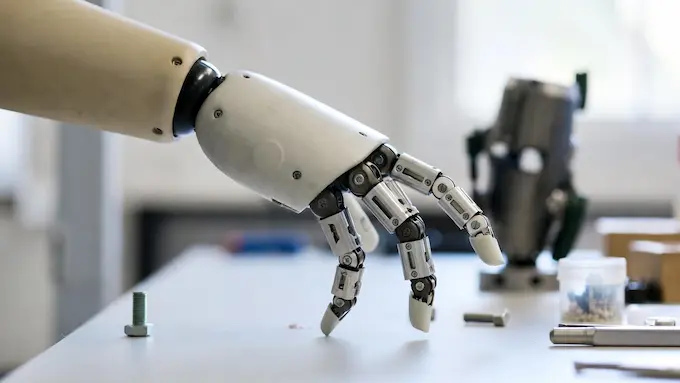
Engineers demonstrated a robotic hand that can detach at the wrist and “scurry” on its fingers to retrieve objects in hard-to-reach or unsafe areas. Unlike typical grippers, the design emphasizes mobility and adaptability, letting the hand move independently rather than relying on an arm to position it.
Why it matters: modular robot parts that can separate and reconfigure could make inspection, recovery, and maintenance safer in hazardous environments. It’s also a glimpse of robots becoming less “single-body” machines and more flexible tool-systems.
Key points
- Detachable end-effector can crawl to objects rather than waiting for an arm to reach
- Designed for constrained or hazardous spaces where people shouldn’t reach
- Highlights a broader trend toward modular, reconfigurable robotics
2) China’s humanoid push accelerates with fast iteration
“China’s humanoid robot ecosystem scales up | Weekly Robotics News | The Bolt and the Byte”
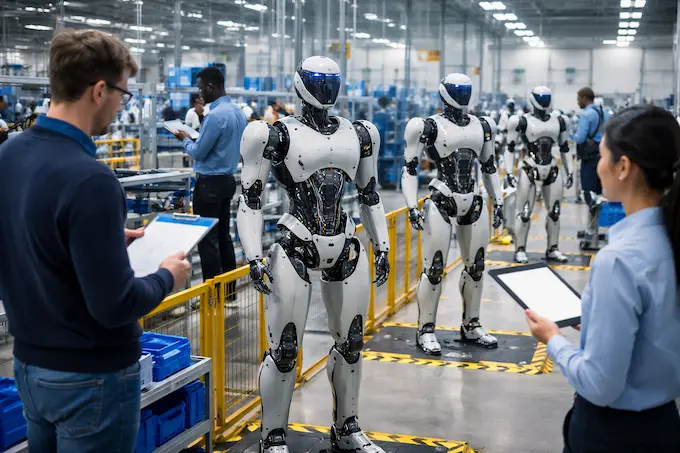
A WIRED report highlights how Chinese humanoid robotics is advancing quickly through tight supply chains, aggressive iteration cycles, and a crowded competitive field. Companies like Unitree are showcased as examples of rapid engineering progress paired with comparatively lower costs.
Why it matters: if humanoid robots are to move from demos into real workplaces, manufacturing scale and iteration speed may matter as much as AI breakthroughs. The story also underlines the competitive pressure on U.S. and European humanoid programs.
3) AI-driven forest navigation blends perception + learning
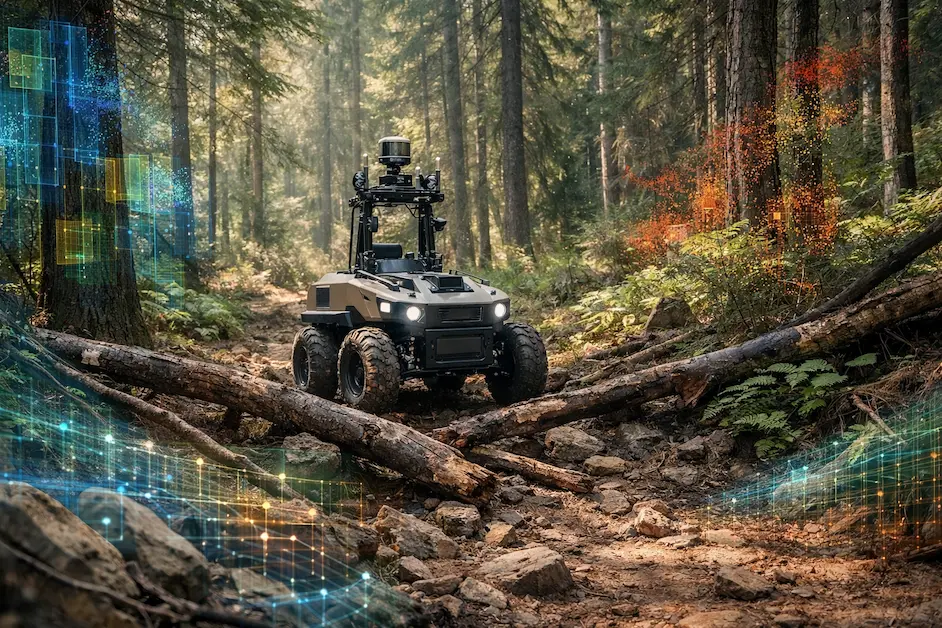
“Robots learn to navigate messy forest trails | Weekly Robotics News | The Bolt and the Byte”
A Scientific Reports paper describes a hybrid approach for autonomous navigation in dense, unstructured environments like forests, combining deep semantic perception with learning-based control. The focus is on handling cluttered visuals, uneven terrain, and unreliable GPS—common failure points for outdoor robots.
Why it matters: better off-road autonomy expands real-world deployment for search-and-rescue, environmental monitoring, and forestry operations—areas where robots must handle uncertainty without perfect maps.
4) Active SLAM aims to stay reliable in dynamic scenes
“Smarter SLAM planning for moving, messy spaces | The Bolt and the Byte”
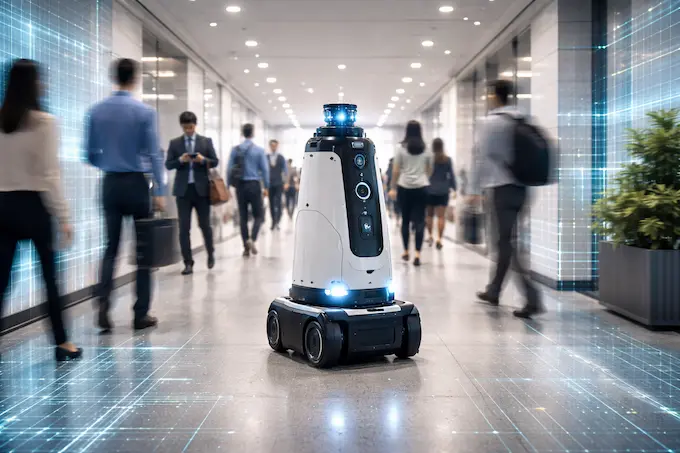
Another Scientific Reports paper tackles active SLAM decision-making, aiming to improve mapping and localization when environments include moving objects that can corrupt tracking. The work emphasizes better “where to look/go next” decisions to maintain accuracy.
Why it matters: warehouses, hospitals, and public spaces are dynamic. If robots can keep mapping reliably while people and objects move, deployments become safer and more scalable.
5) Multi-agent planning claims better robot task coordination
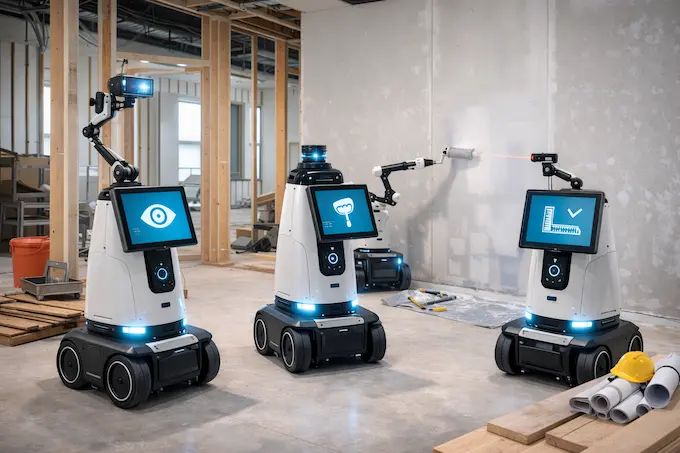
“Four-agent AI planning beats a single brain | Weekly Robotics News | The Bolt and the Byte”
A report describes research where a multi-agent system (several specialized AI agents collaborating) generates action plans for construction-robot roles like inspection or finishing tasks. The key idea is coordination: different agents propose, critique, and refine plans rather than relying on one model’s output.
Why it matters: as robots take on longer, multi-step jobs, planning errors become expensive. Multi-agent workflows could reduce mistakes, improve robustness, and make robot deployments easier to supervise.
6) Serve Robotics buys hospital-assistant robot maker Diligent
“Sidewalk delivery firm moves into hospitals | Weekly Robotics News | The Bolt and the Byte”
Serve Robotics announced it is acquiring Diligent Robotics, known for hospital assistant robots that handle internal logistics like transporting supplies. The deal signals Serve’s expansion beyond sidewalk delivery into healthcare operations.
Why it matters: hospitals are high-value automation environments where “boring but essential” transport tasks consume staff time. If autonomy proves dependable indoors, healthcare could become a major next market for service robotics—an important theme in weekly robotics news.
Key points
- Expands from last-mile delivery into hospital workflows
- Highlights demand for labor-saving internal logistics in healthcare
- Tests whether autonomy platforms can transfer across environments
7) DEWALT unveils fleet-capable downward drilling robot
“Autonomous drilling targets data center build speed | The Bolt and the Byte”
DEWALT announced a downward drilling robot designed to operate as part of a coordinated fleet, aiming to speed up repetitive drilling work in data center construction. The pitch focuses on productivity, consistency, and jobsite safety for high-volume drilling tasks.
Why it matters: construction automation is shifting from single machines to “systems”—robots plus orchestration. Data centers are a strong early market because schedules are intense and tasks are repeatable.
8) Data center timelines could shrink with autonomous drilling fleets
“Robot drilling claims major schedule cuts | Weekly Robotics News | The Bolt and the Byte”
An engineering coverage piece details how fleet-based autonomous drilling could reduce construction timelines by handling high-volume drilling faster than conventional methods. Beyond speed, it highlights safety improvements by reducing manual drilling exposure.
Why it matters: if real-world productivity gains hold up, construction robotics could shift from pilot projects into standard procurement—especially for data centers, factories, and logistics hubs.
9) Microscopic robots become programmable and autonomous
“Tiny robots near the limit of visibility | Weekly Robotics News | The Bolt and the Byte”
Researchers reported “world’s smallest” programmable autonomous robots at micro-scale, designed to sense and respond to their surroundings. The emphasis is on low cost, long operation time, and deploying many units as a swarm rather than relying on one expensive machine.
Why it matters: micro-robots could open new paths in medical procedures, micro-manufacturing, and environmental sensing—areas where conventional robots can’t physically fit.
10) Skild AI hits ~$14B valuation after major funding
“Big money floods ‘physical AI’ with Skild round | Weekly Robotics News | The Bolt and the Byte”
Skild AI reportedly raised about $1.4B and reached a valuation above $14B, underscoring investor confidence in foundation-model approaches for robotics. The round reflects the belief that general-purpose “robot brains” could become a platform layer across many machines and industries.
Why it matters: funding at this scale can accelerate compute, data collection, and partnerships—key constraints for robotics AI. It also raises the stakes: expectations will be high for measurable deployment results, not just demos.
Key points
- Signals strong investor conviction in general-purpose robotics AI
- Could intensify competition for robotics data, talent, and compute
- Puts pressure on real-world deployment and safety validation
11) Delivery robot gets destroyed after stalling on train tracks
“Sidewalk robots meet rail reality in Miami | The Bolt and the Byte”
A video captured a food delivery robot stuck on railroad tracks in Miami before an oncoming train hit and destroyed it. No injuries were reported, but the incident spread widely as a reminder of edge-case safety risks.
Why it matters: delivery robots operate in complex public spaces where rare scenarios can be catastrophic. The path from pilot programs to city-wide deployment depends on stronger fail-safes, remote intervention workflows, and infrastructure-aware routing.
12) UAE debuts autonomous road-cleaning robots
“Road-cleaning robots arrive in Abu Dhabi | Weekly Robotics News | The Bolt and the Byte”
A regional weekly highlight notes autonomous road-cleaning robots being showcased in Abu Dhabi, positioned as smart-city infrastructure tech designed for local conditions, including heat and safety requirements. The broader theme is municipal automation moving from concept to procurement.
Why it matters: city services (cleaning, inspection, maintenance) are a growing automation category. Real deployments in challenging climates can validate reliability—and open export markets for robotics vendors.
13) Li Auto reorganizes its foundation-model strategy
“An EV maker doubles down on embodied AI | The Bolt and the Byte”
Li Auto reportedly reshuffled its foundation-model strategy and integrated VLA development under new leadership, positioning it as a core company-level effort. The move signals continued investment in “embodied” intelligence—AI that can perceive, plan, and act in the physical world.
Why it matters: automakers increasingly treat AI as a platform advantage, not just a feature. Organizational changes can be a leading indicator that companies are preparing for longer-term autonomy and robotics roadmaps.
14) Vdigm pitches AI avatar motion tech for humanoid training

“AI avatars become training data for humanoids | Weekly Robotics News | The Bolt and the Byte”
Vdigm describes technology for generating and animating AI avatars using motion tracking and generative methods, framing it as a way to collect motion data and build “AI twin” training environments for humanoid robots. The approach links entertainment-style avatar pipelines with robotics training needs.
Why it matters: humanoids require massive, high-quality motion datasets. If avatar platforms can generate useful motion primitives and simulation assets, they could become an unexpected upstream supplier to robotics.
15) Autonomy video highlights robotaxis, remote driving, and aerial concepts
“Mobility autonomy diversifies beyond robotaxis | The Bolt and the Byte”
A video roundup shows a mix of autonomy concepts—robotaxis, remotely operated driving models, and other experimental mobility approaches. The theme is that “autonomous transport” is no longer one product category, but a spectrum of automation levels and business models.
Why it matters: robotics and autonomy are converging in mobility, where safety, regulation, and real-world operations dominate. Progress may come from hybrid models (remote support + autonomy) before fully driverless systems become widespread.
Weekly Robotics News – FAQs
1) Why do modular robot parts (like a detachable hand) matter?
They can reach places a full robot can’t, and they reduce risk when tasks happen in hazardous environments. Modular systems also let companies swap tools quickly, improving uptime and flexibility—an emerging theme in weekly robotics news.
2) Are humanoid robots close to real workplace adoption?
They’re improving fast, but many still struggle with fine manipulation, reliability, and cost. Manufacturing scale and iteration speed are helping, yet real deployment depends on safety, training data, and clear ROI.
3) Is this research, prototype work, or commercial product?
This week spans all three: academic papers on navigation/SLAM, productized construction robotics, and real-world service robot deployments (plus failures). The mix is typical: research hardens into pilots, then into commercial tools where the economics work.
4) How soon could construction robots become “standard” on job sites?
Some specialized tasks may scale sooner because they’re repetitive and measurable (like drilling). Wider adoption depends on integration with scheduling, safety processes, and fleet management—often harder than the robot hardware itself.
5) Which industries are most affected by service-robot expansion?
Healthcare logistics, last-mile delivery, and municipal services are seeing steady automation pressure. These sectors value reliability and safety over flashy capabilities—so incremental improvements can unlock large deployments.
6) Why does big funding in “physical AI” matter?
Large rounds can speed up compute, hiring, data partnerships, and deployment programs—key bottlenecks for robotics AI. The tradeoff is higher expectations: investors will look for real-world performance, safety validation, and business traction.
Conclusion
This week’s developments point to robotics maturing into systems: fleets in construction, autonomy with remote support in mobility, and practical service robots expanding into hospitals and cities. At the same time, foundational research in navigation and mapping continues to push reliability in messy, dynamic environments.
The bigger trend in weekly robotics news is the tightening loop between AI progress, commercialization, and safety/regulatory reality—especially as humanoids and public-space robots move closer to wider deployment. Next week, watch for more signals on real-world rollout scale (not just demos) and how companies handle the hardest edge cases.



