

Table of Contents
Boston Dynamics Spot robot is a commercial quadruped (“robot dog”) built to do one job extremely well: reliable mobility + repeatable data collection in places that are awkward, risky, or time-consuming for humans. Instead of trying to be a general-purpose humanoid, Spot focuses on moving through real facilities—stairs, tight corridors, uneven ground—while carrying sensors and running repeatable inspection routes.
Spot’s popularity online often creates unrealistic expectations (like “can it do house chores?”). The reality is more interesting: Spot is a high-end mobile inspection platform used by industrial teams to automate site walks, capture visual/thermal/audio data, and keep people away from hazards. Boston Dynamics explicitly positions Spot for industrial inspection use cases.
The Boston Dynamics Spot robot’s popularity online often creates unrealistic expectations (like “can it do house chores?”). The reality is more interesting: Spot is a high-end mobile inspection platform used by industrial teams to automate site walks, capture visual/thermal/audio data, and keep people away from hazards. Boston Dynamics explicitly positions Spot for industrial inspection use cases.
1) What Spot is designed for
The core value: repeatable mobility in “human spaces”
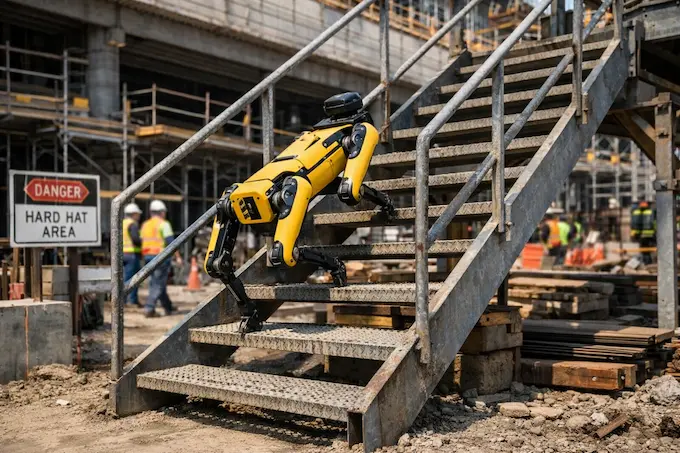
Most industrial environments aren’t robot-friendly. There are stairs, narrow walkways, debris, temporary barriers, changes day-to-day, and uneven surfaces. Wheeled robots can be great on smooth floors—but struggle on steps and rough terrain. Spot is built specifically to handle those conditions, with published mobility limits like:
- Max speed: 1.6 m/s
- Max slope: ±30°
- Max step height: 300 mm
These numbers matter because they map directly to real sites: stairs, ramps, curbs, and industrial thresholds.
The second value: consistent inspection data
Spot is often deployed to:
- Walk the same route every day/week
- Capture consistent photos/video
- Add thermal checks, acoustic readings, or 3D scan payloads (depending on configuration and add-ons)
- Send the data to a dashboard/workflow for maintenance teams
Boston Dynamics markets Spot as “the new standard for industrial inspection,” emphasizing routine + hazardous inspections and improved uptime.
2) Capabilities (what Spot can do well)
A) Remote operation (teleoperation)
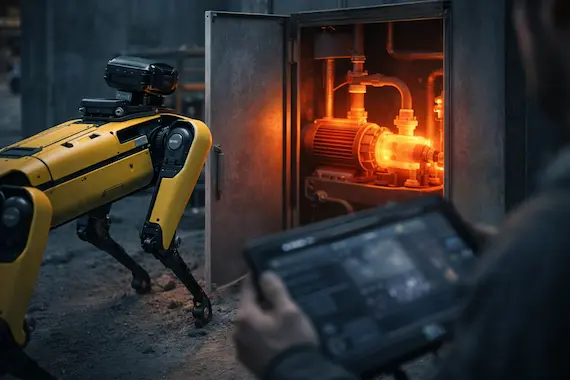
Spot can be driven remotely through facilities to “get eyes on” environments without putting a person in danger. This shows up in industrial maintenance and public safety contexts, especially where you want quick visual confirmation before sending people in.
B) Autonomous routes and repeated missions
A huge reason companies buy Spot is the “repeatable route” concept: record a route once, then replay it to repeat the inspection. Boston Dynamics support docs describe site inspection missions using tools like Autowalk and Orbit workflows for repeating inspections.
In practice, the autonomy story is usually:
- An operator records a mission (route + actions like “take photo here”).
- Spot replays the mission.
- Operators intervene only when needed.
This is not sci-fi autonomy—it’s industrial reliability autonomy.
C) Payload carrying (Spot as a sensor platform)
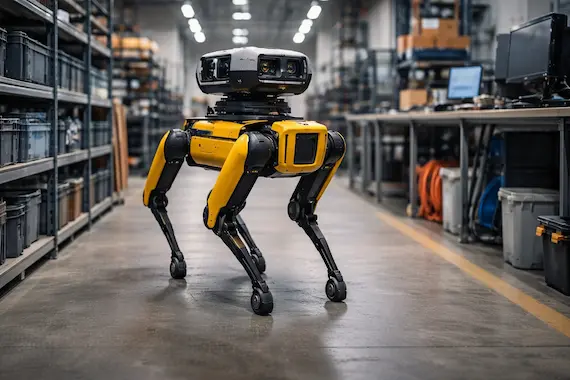
Spot is valuable because it’s a moving sensor base. Officially, Spot supports up to 14 kg (30.9 lbs) payload.
That’s enough for many useful inspection setups (e.g., thermal + data capture + compute payload), depending on mounting and power.
D) Obstacle awareness and terrain sensing
Spot’s published sensing includes:
- 360° horizontal field of view
- 4 m range
- > 2 lux lighting
- Collision avoidance behavior (“maintains set distance from stationary objects”)
This matters because “stability” isn’t only legs—it’s also how well the robot perceives nearby obstacles and avoids bumping into them.
3) Limitations (what Spot is NOT)
This is the part that prevents disappointment.
Not a household helper
Spot is not designed to:
- cook, clean your room, fold laundry
- understand complex open-ended instructions
- reliably do delicate object manipulation by default
When Reddit talks about “could it be a guide dog / companion / home assistant,” the recurring theme is: mobility is there, but real-world “intelligence” and cost make it impractical today.
Not an “all day” runtime robot
Spot’s typical runtime is ~90 minutes and standby 180 minutes, with 60 minutes recharge per official specifications.
That’s strong for a legged platform, but it means real deployments plan for:
- battery swaps
- docking/charging schedules
- mission batching
IP54 ≠ waterproof
Spot is rated IP54.
That generally implies dust protection (limited ingress) and protection against water splashes—not heavy washdown or submersion. If your environment is washdown-grade (food processing, heavy rain exposure, hoses), you must plan accordingly (or pick a different solution).
4) Full specifications (official) + “why it matters”
| Specification | Official Value | Why it matters |
|---|---|---|
| Payload (max) | 14 kg (30.9 lbs) | Determines which sensor stack you can carry (thermal, lidar, compute payloads, etc.). |
| Typical runtime | ~90 minutes | Defines how long a mission can run before battery swap / recharge planning. |
| Recharge time | ~60 minutes | Controls mission scheduling and robot utilization across shifts. |
| Ingress protection | IP54 | OK for dust + splashes; not intended for heavy washdown or submersion. |
| Operating temperature | -20°C to 55°C | Important for outdoor sites, cold rooms, and hot industrial environments. |
| Max speed | 1.6 m/s | Faster transit between inspection points = shorter missions. |
| Max slope | ±30° | Shows whether ramps and uneven terrain are realistic for your site. |
| Max step height | 300 mm | Key for stairs, curbs, and industrial thresholds. |
| Terrain sensing | 360° / 4 m range | Helps with obstacle awareness; low-light conditions still need planning. |
Source: Boston Dynamics Spot product specs and spec sheets. (Cite in article text where needed.)
Below are the key specs people search for, with “why it matters” next to each.
Battery and power (the first buyer question)
From Boston Dynamics product specs and support documentation:
- Battery capacity: 564 Wh
- Typical runtime: ~90 minutes
- Standby time: 180 minutes
- Recharge time: 60 minutes
Why it matters: your inspection program will be designed around runtime windows. Many teams build missions that fit inside one battery run and rotate batteries to keep utilization high.
Mobility and environment
- Max speed: 1.6 m/s
- Max slope: ±30°
- Max step height: 300 mm
- Operating temperature: -20°C to 55°C
- Ingress Protection: IP54
Why it matters: these specs determine whether Spot can handle your stairs, ramps, winter conditions, and dust exposure.
Payload and integration
Spot supports payload integration with mounting and power details (from Spot spec sheet):
- Payload: 14 kg (30.9 lbs)
- Mounting volume: 0.85 m (L) × 0.24 m (W) × 0.27 m (H)
- Mounting interface: M5 T-slot rails
- Connector: DB25 (2 ports)
- Power: Unregulated DC, 150W
Why it matters: if you want Spot to carry your thermal camera, acoustic sensor, lidar, or custom compute module, these are the constraints your integrators live by.
5) Benchmarks: what buyers compare (and how to interpret them)
| Buyer Benchmark | Spot’s published value | How to interpret it |
|---|---|---|
| Mission length | ~90 min runtime | Design routes to 45–70 minutes for buffer and reliability. |
| Stairs/steps | 300 mm step height | Works for many stairs and curbs; validate on your site geometry. |
| Ramps/grades | ±30° slopes | Good for common ramps; slick surfaces still require safety controls. |
| Outdoor readiness | IP54, -20°C to 55°C | Generally suitable for dust/splashes; avoid washdown/submersion scenarios. |
| Sensor stack capability | 14 kg payload + mounting/power | Check not only weight, but power budget + cable routing + mounting volume. |
Specs are numbers; benchmarks are “does this match the job?”
Runtime benchmark: “Can it finish one inspection route?”
If your route takes 60 minutes, Spot’s ~90-minute typical runtime gives you buffer (but payload, terrain, and mission behavior can reduce runtime).
A strong deployment pattern is:
- design routes for 45–70 minutes
- keep spare batteries ready
- create multiple missions rather than one huge mission
Mobility benchmark: “Can it reach the places we need?”
A slope limit of ±30° and step height 300 mm is meaningful because many industrial stairs and ramps fall within that range.
Payload benchmark: “Can it carry our sensor stack?”
14 kg is significant for a legged robot.
But the real benchmark is not only weight: it’s weight + power + mounting + cable management + mission integration.
Environment benchmark: “Is it OK with dust, temperature, light?”
Spot’s IP54 and -20°C to 55°C range covers many typical industrial and outdoor edge cases.
Also note the >2 lux reference in terrain sensing (very dark environments may require additional lighting planning).
6) Price: base headline vs real-world deployment cost
The famous number: $74,500
| Cost Item | Common in real deployments? | Why it’s needed |
|---|---|---|
| Base robot (headline) | Yes | Entry price most people search for (reported $74,500 in major coverage). |
| Extra batteries | Usually | Keeps missions running while charging cycles happen. |
| Payloads (thermal/acoustic/3D) | Often | Turns Spot from “mobile camera” into a true inspection tool. |
| Training & support | Recommended | Safety, operations, and consistent usage patterns improve ROI. |
| Integration work | Often | Connect data outputs to reporting dashboards and maintenance workflows. |
Major outlets reported Spot going on sale for $74,500 (commercial purchase context).
This is the number people repeat online and on Reddit threads about Spot’s cost.
The real pricing reality (what buyers should budget)
The base robot is rarely the entire project cost. Real deployments often add:
- extra batteries (to keep missions running)
- payloads (thermal, acoustic, lidar, etc.)
- training, support, and safety planning
- integration work (data pipelines, dashboards, CMMS/asset systems)
- possibly docking/autonomy workflow tools (depending on your approach)
So when someone asks “What is Spot’s price?”, the honest answer is:
- Base purchase headline: $74,500 (historically reported)
- Total program cost: depends heavily on payloads + operat
7) Buying checklist: is Spot a good fit for your use case?
Use this section as a decision filter:
Spot is a great fit if you need:
- inspections in areas with stairs / uneven ground / narrow passages
- repeatable visual capture (same angle/location each time)
- remote operation to keep people away from hazards
- a mobile sensor base for your inspection program
- an SDK/platform for automation engineering (common with enterprise robotics teams)
Spot is NOT a great fit if:
- your site is mostly smooth floors and wide corridors (wheeled robots may be cheaper)
- you need heavy manipulation work (Spot is primarily a mobility + sensing platform)
- you need washdown-grade protection or harsh water exposure (IP54 constraints)
- you expect a consumer-style “robot pet” experience
8) FAQs (inspired by Reddit + common searches)
1) How much does Boston Dynamics Spot cost?
Reported “buy” price for Spot sales has been $74,500 in major coverage of its commercial availability.Most real deployments cost more due to payloads, spares, and operations.
2) What is Spot’s battery life?
Official specs list ~90 minutes typical runtime, 180 minutes standby, and 60 minutes recharge.
3) How much payload can Spot carry?
Spot supports up to 14 kg (30.9 lbs) payload.
4) Can Spot climb stairs?
Spot is designed for complex terrain and lists a max step height of 300 mm and slope capability ±30°, which supports stair and ramp scenarios.
5) Is Spot waterproof?
Spot is IP54, which means limited dust ingress protection and splash protection—not submersion or heavy washdown.
6) Can I program Spot?
Spot is sold as a platform with APIs/SDK support and integration documentation described in its spec sheets and platform materials.
7) What is Spot typically used for?
Boston Dynamics highlights industrial inspections (routine and hazardous), and support materials describe repeated “site inspection mission” workflows.
8) Why is Spot so expensive?
Spot’s cost reflects high-end legged mobility, industrial-grade controls, safety, and a commercial support ecosystem. In coverage of Spot’s sales, it’s consistently framed as an industrial tool rather than a consumer robot.
Sources used for accuracy
Boston Dynamics Spot product specs page ( https://bostondynamics.com/products/spot/?utm_source=chatgpt.com)
Boston Dynamics Support: Spot Specifications (https://support.bostondynamics.com/s/article/Spot-Specifications-49916?utm_source=chatgpt.com)
Boston Dynamics spec sheet / payload integration details
Price coverage: The Verge / IEEE Spectrum / VentureBeat / Wired (https://www.theverge.com/21292684/boston-dynamics-spot-robot-on-sale-price?utm_source=chatgpt.com)
Mission workflow doc (Autowalk + Orbit inspection missions)
Reddit threads referenced for FAQ themes



