

Table of Contents
1. China debuts modular AI “service space” with humanoid barista
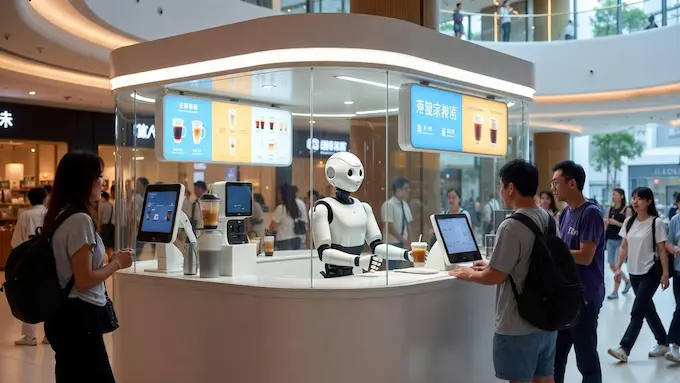
Short one-line hook | Weekly Robotics News | The Bolt and the Byte
Chinese startup AI² Robotics has revealed ZhiCube, a modular “embodied AI service space” that houses its AlphaBot 2 humanoid robot in a compact, swappable kiosk. Deployed in locations like parks and shopping malls, each unit can be configured for coffee, ice cream, retail, or entertainment. Interesting Engineering
The system uses the company’s full-body embodied model GOVLA to let humans and robots share tasks and dynamically switch roles depending on foot traffic. Long-term plans call for thousands of ZhiCube units across China, positioning the platform as a piece of urban infrastructure rather than a one-off novelty. Interesting Engineering
For readers following weekly robotics news, ZhiCube is a strong signal that humanoids are moving from factory pilots into public-facing, revenue-generating deployments.
Key points
- ZhiCube is a modular kiosk with a humanoid robot inside
- Swappable modules: coffee, ice cream, retail, entertainment
- Uses an embodied AI model to share work between humans and robots
- Company aims for large-scale nationwide deployment
2. XPENG CEO: 2026 will be the breakout year for AI-driven robotics
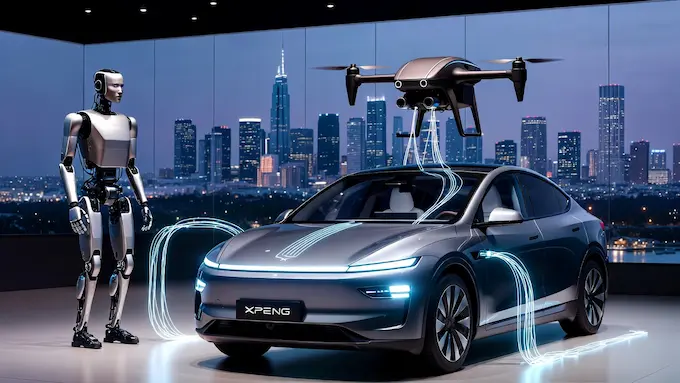
AI mobility, walking robots and drones all converge | Weekly Robotics News | The Bolt and the Byte
In a recent Silicon Valley video briefing, XPENG CEO He Xiaopeng called 2026 a turning point for AI-driven robotics, spanning autonomous cars, legged robots and flying drones. He argued that advanced AI will unify these platforms into a broader mobility and robotics ecosystem rather than treating them as separate silos. Blockchain News
XPENG frames this as both a technology shift and a business opportunity: logistics, smart transportation and human–robot collaboration could all benefit as AI models move from the cloud into embodied systems. For weekly robotics news watchers, it’s another sign that carmakers are quietly turning into full-stack robotics companies.
Key points
- XPENG sees AI robotics as the key trend for 2026
- Focus spans autonomous vehicles, legged robots and drones
- Strategy is about one integrated mobility-and-robotics stack
3. Long-term robotics bets: three stocks riding the automation wave
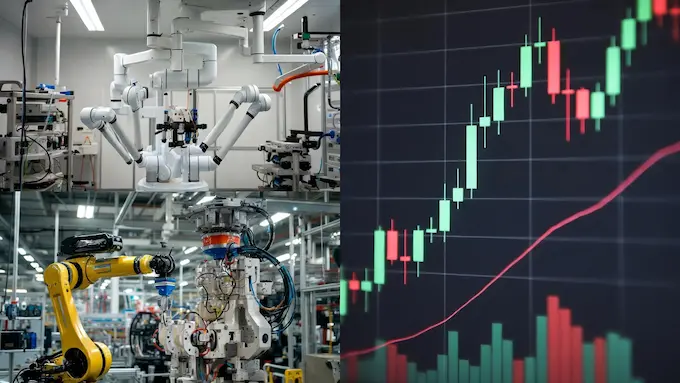
Investors hunt durable gains in automation and AI | Weekly Robotics News | The Bolt and the Byte
A recent analysis highlights three companies as long-term winners in the global robotics industry, especially for investors with $2,000 or more to deploy. The list includes a surgical-robotics leader, Medtronic with its Hugo robotic surgery platform, and Teradyne, which blends semiconductor test equipment with collaborative and mobile robots. The Motley Fool
The thesis is simple: as robots move from pilot projects to scaled deployment in factories, hospitals and logistics hubs, suppliers of core platforms and enabling technology stand to benefit over the next decade. For readers of weekly robotics news, the piece underlines how robotics is increasingly treated as a mainstream, buy-and-hold growth theme rather than a speculative side bet.
Key points
- Focus on buy-and-hold robotics stocks for at least a decade
- Includes surgical robotics and industrial test-plus-automation players
- Thesis: robotics demand compounds across healthcare, industry and logistics
4. Humanoid hype dominates 2025’s top robotics stories
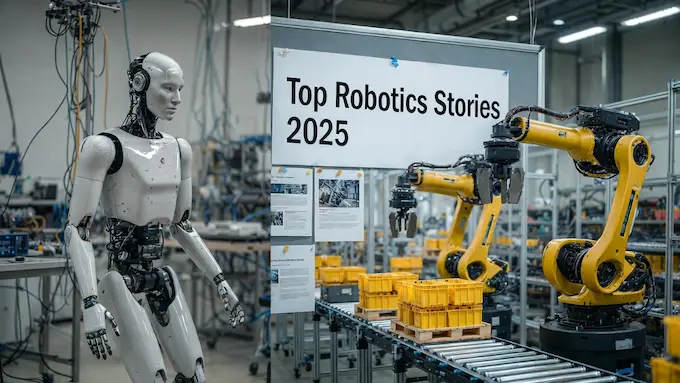
From Amazon’s warehouse bots to Atlas’ new tricks | Weekly Robotics News | The Bolt and the Byte
IEEE Spectrum’s roundup of 2025 robotics milestones shows just how quickly humanoids have moved into the spotlight. The list includes Amazon’s Vulcan warehouse robots that stow items faster than humans, and Boston Dynamics’ Atlas now guided by large behavior models to handle more complex tasks. IEEE Spectrum+1
At the same time, the editors caution that delivering on the humanoid promise at scale remains extremely hard. The takeaway for weekly robotics news readers is nuanced: humanoids are advancing fast, but the most commercially successful robots are still the ones doing focused, repetitive work in structured environments.
Key points
- 2025’s biggest stories skew toward humanoid platforms
- Amazon’s Vulcan and Boston Dynamics’ Atlas show real-world progress
- Editors warn against over-hyping humanoids before they scale commercially
5. MIT’s “speak objects into existence” robots blur design and fabrication
Natural language turns into physical furniture in minutes | Weekly Robotics News | The Bolt and the Byte
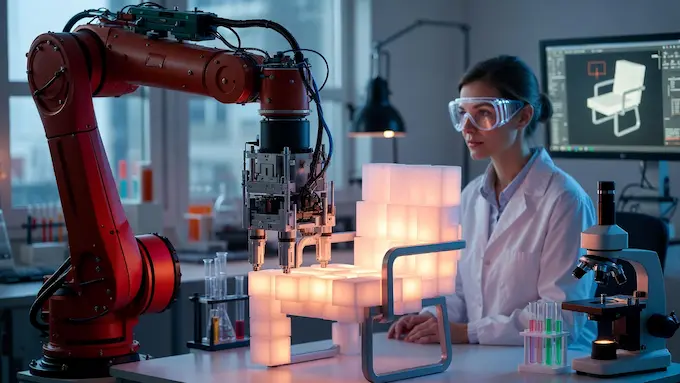
MIT researchers have unveiled a system where users can describe an object in natural language—such as “I want a chair”—and see a robot assemble it from modular cubic components within minutes. An AI model handles design generation, geometric constraints and a feasible assembly sequence, while a robotic arm builds the object. MIT News+1
The platform is pitched as a bridge between humans, AI and robots, making it possible for non-experts to co-create physical structures without learning CAD or low-level robot programming. For weekly robotics news followers, this points to a future where manufacturing feels less like coding and more like conversation.
Key points
- Users describe objects in plain language; robots assemble them
- System accounts for real-world constraints and assembly order
- Aims to democratize design and reduce material waste via reassembly
6. Hyundai to lay out AI robotics roadmap at CES 2026
Auto giant aims to connect cars, robots and smart cities | Weekly Robotics News | The Bolt and the Byte
Hyundai Motor Group plans to unveil a dedicated AI robotics strategy at CES 2026, highlighting how robots fit into its broader “future mobility” vision. The company has already invested heavily in robotics, and the new strategy is expected to tie together intelligent vehicles, service robots and logistics platforms under one AI stack. HYUNDAI MOTORS
For weekly robotics news readers, a major automaker using CES to talk explicitly about robotics—not just cars—signals that robots are now seen as core infrastructure for transportation, logistics and urban life, not a side project.
7. Six humanoid robots steal the show at Chengdu concert
Unitree’s dancers impress both fans and Elon Musk | Weekly Robotics News | The Bolt and the Byte
At a recent concert in Chengdu, six humanoid robots from Unitree Robotics performed alongside singer Wang Leehom, executing synchronized arm waves, kicks, turns and even Webster flips. Videos from the event quickly went viral on Chinese social media. Global Times
Elon Musk amplified the moment by reposting the clip on X and calling the performance “impressive.” For the broader weekly robotics news narrative, the spectacle highlights how humanoids are moving from lab demos and trade shows into mainstream culture, shaping public expectations long before mass deployment.
Key points
- Six Unitree humanoids danced on stage at a major concert
- Musk’s “impressive” comment boosted global attention
- Public shows are becoming a proving ground for humanoid capabilities
8. How Japan’s robotics pioneer status missed the humanoid moment
Factory success, consumer hesitation | Weekly Robotics News | The Bolt and the Byte
A report from the South China Morning Post explores how Japan, long a pioneer in industrial robotics, has struggled to capitalize on the recent humanoid boom. While Japanese firms dominate factory automation, they have been slower to ship general-purpose humanoids aimed at logistics, services or home use. South China Morning Post
The article points to structural factors: conservative corporate cultures, focus on proven industrial segments, and hesitation around high-risk, high-hype humanoid ventures. For weekly robotics news readers, it’s a reminder that leadership in one robotics era doesn’t automatically guarantee leadership in the next.
9. China wrestles with a possible humanoid robot “bubble”
Investors race ahead while regulators grow cautious | Weekly Robotics News | The Bolt and the Byte
Commentary highlighted by Futurism notes that some investors see humanoid robots as the next financial bubble, especially in China where valuations and startup counts are soaring. Analysts warn that expectations for near-term mass deployment may be out of sync with the technical and commercial realities of humanoid systems. Futurism
The tension matters for weekly robotics news because boom-and-bust cycles can distort the ecosystem: short-term hype attracts capital, talent and attention, but over-promising risks a backlash that might slow genuinely useful deployments. The challenge for policymakers and founders alike is to channel enthusiasm into sustainable, real-world use cases rather than speculative hype alone.
10. One-yuan “flash rental” brings robots to ordinary Chinese streets
Low-cost rentals push service robots into the mainstream | Weekly Robotics News | The Bolt and the Byte
SiliconANGLE reports that Chinese company Qingtianzhu is testing a 1 RMB (about $0.14) “flash rental” model for service robots, allowing businesses to try robots in real-world settings with minimal upfront cost. The program targets small shops and local services rather than only large enterprises. SiliconANGLE+1
The idea sits neatly beside Elon Musk’s vision of “robots everywhere,” which syndicated coverage notes China may be closest to realizing by combining aggressive manufacturing, supportive policy and creative business models. netdania.com For weekly robotics news readers, this is a glimpse of how pricing and access models could be just as important as hardware in driving real deployment.
Key points
- Qingtianzhu offers ultra-cheap, short-term robot rentals
- Targets everyday businesses, not just big factories
- Aligns with broader vision of ubiquitous humanoid and service robots
11. Pipe-crawling robot with 3D-printed spine tackles hard-to-reach infrastructure
Soft-spine design reduces motors and boosts agility | Weekly Robotics News | The Bolt and the Byte
Interesting Engineering covers a new robot designed to crawl through tight pipes and confined spaces using a 3D-printed flexible spine rather than a forest of individual motors. The design lets the robot snake around bends and obstacles while keeping the mechanical complexity low. Interesting Engineering+1
Such robots are crucial for inspecting and maintaining aging infrastructure like water and gas pipelines without costly excavation. For weekly robotics news, this is a reminder that some of the most impactful robots never interact with consumers at all—they work quietly out of sight, preventing failures before they happen.
12. China reimagines Asimov with 24 new “laws” for robots and AI
From sci-fi ethics to real-world regulation | Weekly Robotics News | The Bolt and the Byte
A Forbes piece describes how China has introduced a detailed set of 24 provisions for robots and AI, prompting comparisons to Isaac Asimov’s famous Three Laws of Robotics. Unlike Asimov’s fictional rules, these are policy guidelines with real implications for developers and operators. Ground News+1
The framework sets expectations around safety, human control and accountability, but also raises questions about how such rules will be monitored and enforced across a fast-moving robotics sector. For weekly robotics news readers, it underscores how the center of gravity for robot governance is shifting toward countries deploying large numbers of embodied systems at scale.
13. Surgerii Robotics raises $100M to scale single-port surgical robot
Chinese med-tech bets on less-invasive surgery worldwide | Weekly Robotics News | The Bolt and the Byte
Surgerii Robotics has secured a Series D round of around $100 million to accelerate global deployment of its SHURUI single-port surgical robot, according to multiple reports and corporate disclosures. IRCAD+3The Robot Report+3vcbeatglobal.com+3
The system has already received CE certification in Europe and is being integrated into leading training centers, positioning it as a challenger in a market long dominated by a few incumbents. For weekly robotics news, this funding highlights how competition in surgical robotics is intensifying, with new entrants pushing for less-invasive, single-port procedures that may shorten recovery times and broaden access.
Key points
- Surgerii closes a major Series D round
- Funds global rollout of the SHURUI single-port surgical robot
- CE-certified system is already in European training centers
14. DARPA’s triage challenge puts robots on the front lines of disaster response
Autonomous sensing to help medics choose who to save first | Weekly Robotics News | The Bolt and the Byte
IEEE Spectrum profiles DARPA’s Triage Challenge, which tasks teams with building robots that can rapidly assess casualties in mass-casualty scenarios. Instead of replacing medics, the robots are meant to capture vital signs—such as breathing and heart rate—from a distance and feed them into a shared triage map. Invalid URL+1
A medic might wear a vest-mounted smartphone that displays the location and status of each casualty, updated automatically as the robotic team gathers data. For weekly robotics news readers, the project shows how autonomy, sensing and human-centered design can combine to tackle some of the hardest, most time-critical tasks in emergency medicine.
15. Microrobots and embodied AI startups redefine the next decade
From salt-grain robots to full-stack embodied AI platforms | Weekly Robotics News | The Bolt and the Byte
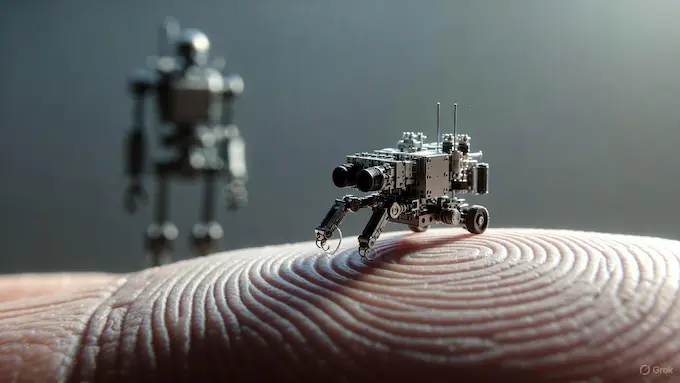
Researchers working with institutions like the University of Pennsylvania and the University of Michigan have developed fully programmable, autonomous robots smaller than a grain of salt. These microrobots integrate onboard computing, temperature sensing and light-powered propulsion, opening the door to applications in medicine, environmental monitoring and microscale manufacturing. zmescience.com+1
On the commercial side, an Analytics Insight roundup names 10 embodied AI companies to watch in 2026, including Neura Robotics with its “cognitive” cobots and PaXini Tech, which builds tactile “skin” for robots. Analytics Insight+1 Together, the research and startup landscapes show how weekly robotics news is increasingly split between robots you can barely see and humanoid platforms meant to share our homes, warehouses and streets.
Key points
- Microrobots combine sensing, computation and motion at microscopic scales
- Embodied AI startups build the hardware and “brains” for next-gen robots
- The field spans everything from cell-scale machines to full-size humanoids
Why is China pushing service and humanoid robots so aggressively right now?
China is combining large-scale manufacturing, government support, and new business models—such as modular service kiosks and ultra-low-cost robot rentals—to move robots from pilots into everyday public use. This strategy, highlighted across multiple stories in this week’s roundup, shows how deployment speed is becoming as important as technical capability in weekly robotics news.
Are humanoid robots actually ready for real-world use, or is this just hype?
Humanoid robots are showing real progress in controlled environments, public demonstrations, and limited commercial roles. However, concerns about a potential “robot bubble” suggest expectations may be running ahead of reliability, cost efficiency, and safety. The reality, as reflected in this week’s stories, sits between genuine capability and unresolved scalability challenges.
What does XPENG’s vision say about the future of robotics beyond cars?
XPENG’s leadership views autonomous vehicles, walking robots, and drones as part of a single AI-driven robotics ecosystem. This signals a broader shift where car companies are evolving into full-stack robotics developers, a trend increasingly visible across weekly robotics news and major technology conferences.
How important is Hyundai’s AI robotics strategy revealed ahead of CES 2026?
Hyundai’s upcoming CES strategy matters because it places robotics at the center of future mobility rather than treating it as an experimental side project. By linking vehicles, service robots, and logistics platforms under one AI framework, Hyundai is positioning robots as long-term infrastructure for cities and industry.
What makes MIT’s “speak objects into existence” research significant?
MIT’s work shows how natural language, AI planning, and robotics can merge into a single workflow where people describe what they want and robots physically build it. This lowers the barrier to manufacturing and design, and it reflects a broader theme in weekly robotics news: making robots easier to use for non-experts.
Why are investors worried about a robotics or humanoid bubble?
Rapid investment, rising valuations, and bold timelines—especially in China—have raised concerns that expectations may exceed near-term commercial reality. While robotics remains a long-term growth sector, some stories this week highlight the risk of overfunding concepts before they prove sustainable use cases.
How do low-cost robot rental models change adoption?
Flash-rental and short-term leasing models allow small businesses to experiment with robots without large upfront investment. This reduces risk and accelerates real-world testing, a theme that stands out in this week’s weekly robotics news as a practical alternative to expensive one-time purchases.
Is Japan falling behind in the humanoid robot race?
Japan remains a global leader in industrial automation, but cultural, economic, and strategic factors have slowed its push into mass-market humanoids. This does not mean Japan is “losing” robotics leadership—rather, it reflects different priorities compared with countries aggressively pursuing general-purpose robots.
What should readers watch next after this week’s robotics developments?
Key areas to monitor include real-world service robot deployments, embodied AI software maturity, regulatory responses to humanoids, and whether large companies can turn high-profile demos into sustainable businesses—recurring themes likely to dominate upcoming weekly robotics news editions.
Conclusion
This week’s stories show a robotics industry moving from experimentation toward everyday presence, while still wrestling with cost, safety, and realistic timelines. From China’s service robots and rental models to automakers redefining themselves as robotics companies, the direction is clear even if the destination is not.
As embodied AI, humanoids, and specialized robots continue to mature in parallel, the most meaningful progress will come from deployments that balance ambition with practicality. Stay tuned for the next edition of Weekly Robotics News, where we’ll continue tracking the signals that matter amid the noise.
— The Bolt and the Byte



