

Table of Contents
1. Telepresence robot helps sick children feel less lonely
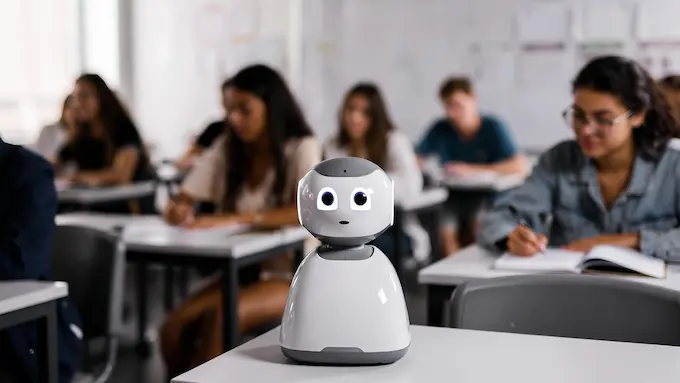
Keeping kids connected to classrooms when they can’t be there in person
A small telepresence robot called AV1, built by Norwegian startup No Isolation, is being used to help children with long-term medical conditions stay connected to school and friends. The robot sits in the classroom as the child’s “avatar,” streaming lessons and social interactions to a tablet or phone at home or in hospital. (euronews)
No Isolation’s founder Karen Dolva says the goal is to make the device emotionally supportive but visually neutral, drawing on animation design principles for a friendly, expressive “head and shoulders” form without looking like a child or adult. As global health agencies warn that loneliness is becoming a public health threat—especially for adolescents—AV1 shows how robotics can be part of a broader toolkit for tackling social isolation. (euronews)
For readers following weekly robotics news, AV1 illustrates the shift from industrial automation to human-centered companionship and inclusion in everyday life.
- Key points:
- AV1 acts as a remote presence robot for children who can’t attend school.
- Design focuses on emotional comfort without being too childlike or humanoid.
- The project responds to rising concerns over loneliness among young people.
2. Hospital delivery robots get precise navigation boost
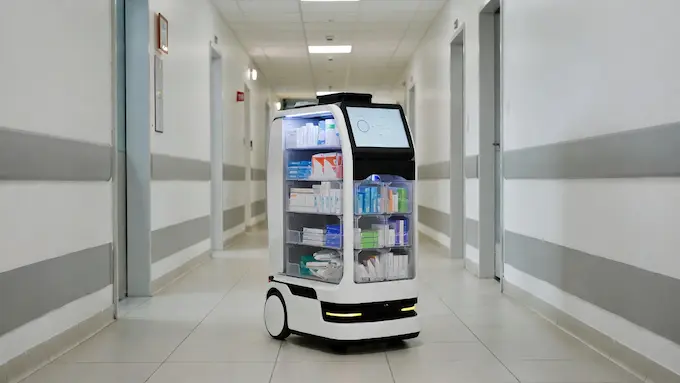
ROS-based drug couriers learn to move safely through crowded wards | Weekly Robotics News | The Bolt and the Byte
A new research paper explores how hospital drug delivery robots can navigate complex indoor environments more safely and efficiently using the Robot Operating System (ROS). The team integrates and tunes SLAM, localization and path-planning algorithms—including gmapping, AMCL, A* and the Dynamic Window Approach—to create a robust navigation pipeline. (SCIRP)
In simulation tests, the robots maintain localization accuracy within 0.1 meters, even when moving near dynamic obstacles such as people and carts. The study finds that route lengths stay close to the theoretical shortest path while average speed remains stable at around 0.5 m/s, suggesting hospital logistics tasks can be automated without sacrificing safety. (SCIRP)
For hospital systems covered in weekly robotics news, these results hint at a near-future where autonomous trolleys quietly ferry medications and supplies, freeing staff for direct patient care.
- Key points:
- ROS-based stack combines gmapping, AMCL, A* and DWA for navigation.
- Positioning error stays below 0.1 m in simulation.
- Robots maintain stable speed while safely avoiding obstacles.
- Image description:
A compact indoor mobile robot with shelves of medicine boxes moves down a hospital corridor, with a nurse and patient blurred in the background, UI overlays subtly indicating its planned path.
3. LG’s CLOiD home robot aims for the “zero labor home”
CES 2026 preview shows domestic robots stepping into everyday chores | Weekly Robotics News | The Bolt and the Byte
LG has announced its new home robot, LG CLOiD, which will debut at CES 2026 in Las Vegas. Designed as a general-purpose household assistant, CLOiD features two articulated arms with seven degrees of freedom each and five-fingered hands capable of performing delicate, human-like tasks—from handling dishes to tidying surfaces. (LG Newsroom)
At the heart of the system is a head-mounted chipset acting as the robot’s “brain,” supported by a display, speakers, cameras and sensors for natural voice interaction and indoor navigation. LG positions CLOiD as part of its “Zero Labor Home” vision, where routine chores are offloaded to intelligent machines so people can focus more on family and leisure. (LG Newsroom)
Within weekly robotics news, CLOiD is a strong signal that home robots are moving from narrow, single-purpose devices toward flexible, multi-task assistants.
- Key points:
- LG CLOiD will be unveiled at CES 2026.
- Dual articulated arms and dexterous hands enable fine manipulation.
- Designed to fit typical home environments and support a “zero labor” lifestyle.
4. KAIST humanoid robot trained for extreme environments
Bipedal robot tackles rough terrain and even lunar-style tests | Weekly Robotics News | The Bolt and the Byte
Researchers at KAIST’s HuboLab have unveiled a next-generation humanoid robot built for challenging industrial and lunar-like environments. The bipedal platform, about 165 cm tall and weighing 75 kg, can run at up to 12 km/h and climb steps up to 30 cm high, thanks to a fully in-house hardware stack from motors to controllers. (Inspenet)
The team uses reinforcement learning-based control, first training policies in simulation before deploying them onto the real robot to bridge the “sim-to-real” gap. A related one-legged robot can perform repeated jumps and 360-degree somersaults, demonstrating advanced balance and control. KAIST is collaborating with MIT and other partners to integrate arms, hands and manipulation for real-world tasks in hazardous environments. (Inspenet)
Stories like this are increasingly central to weekly robotics news as humanoids transition from demos to applications in energy, industry and space.
- Key points:
- KAIST humanoid is optimized for uneven terrain and extreme conditions.
- RL-based controllers are trained in simulation and transferred to hardware.
- Roadmap includes full-body manipulation and complex field tasks.
5. UC Davis launches major hub for agricultural robotics
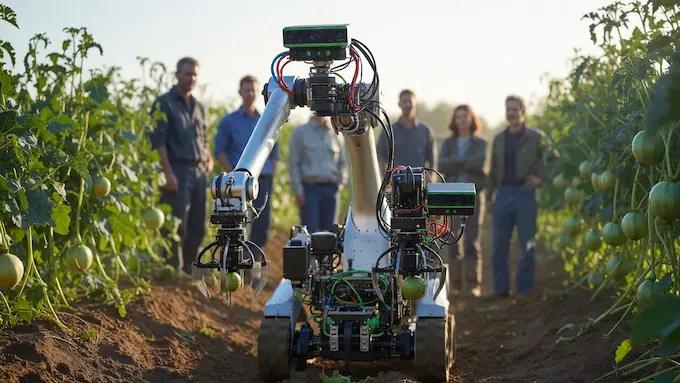
New Resnick Center to unite robots, remote sensing and AI in the fields | Weekly Robotics News | The Bolt and the Byte
The University of California, Davis is establishing the Lynda and Stewart Resnick Center for Agricultural Innovation, a 34,000-square-foot facility that will centralize research into robotics, remote sensing and data-driven farming. The center will include laboratories, classrooms and a fabrication shop for building prototypes like robotic grippers, drone frames and custom sensing rigs. (College of Engineering)
Professor Fadi Fathallah, chair of biological and agricultural engineering, will lead the center’s robotics efforts, focusing on field-ready autonomous platforms for harvesting, pruning and precision spraying. The aim is to co-develop practical robots with growers and industry partners to address labor shortages, efficiency demands and sustainability targets. (College of Engineering)
For readers of weekly robotics news, the Resnick Center is a reminder that some of the most impactful robots may end up in orchards, vineyards and vegetable fields rather than on factory floors.
- Key points:
- New UC Davis center will centralize agricultural robotics and AI research.
- Focus on autonomous field platforms and practical farm tasks.
- Strong emphasis on collaboration with growers and technology firms.
6. “Robot Olympics” tests household bots on real-life chores
Physical Intelligence’s π0.6 robot takes on doors, dishes and dog poop bags | Weekly Robotics News | The Bolt and the Byte
AI startup Physical Intelligence has launched a “Robot Olympics” benchmark for home robots, pitting its π0.6 generalist model against everyday tasks such as opening self-closing doors, turning socks inside out, inserting keys into locks, washing greasy pans and wrestling with thin plastic dog poop bags. (The Neuron)
The system uses a vision-language-action policy—like an LLM for robots—to translate visual input and instructions into motor commands. All challenge runs are claimed to be fully autonomous, with the robot decomposing tasks, making contact-rich moves and recovering from errors without human intervention. By moving beyond lab puzzles to messy household chores, the benchmark probes how close we really are to useful domestic robots. (The Neuron)
Within weekly robotics news, Robot Olympics stands out as an attempt to standardize “real life” tests for embodied AI systems.
- Key points:
- New benchmark focuses on realistic household tasks.
- π0.6 robot uses a vision-language-action model for control.
- All tasks are claimed to run autonomously without human correction.
7. Chinese humanoid robots go viral as concert backup dancers
Unitree’s G1 robots perform flips on stage and catch Elon Musk’s eye
Six G1 humanoid robots from Unitree Robotics performed as backup dancers at a concert by pop star Wang Leehom in Chengdu, where they executed synchronized routines and high-difficulty flips alongside human performers. Video clips of the performance spread quickly on social media and were reposted by Elon Musk, who simply commented “Impressive.” (ECNS)
Unitree says the robots rely on millisecond-level motion response, dynamic balance control and multi-agent coordination to perform in sync without collisions, even under stage lighting and crowded choreography. The appearance underscores how humanoid robots are moving from controlled demos into high-visibility entertainment and cultural events, a recurring theme in weekly robotics news. (ECNS)
- Key points:
- Six Unitree G1 humanoids danced at a major concert in Chengdu.
- Advanced balance and coordination systems enabled flips and tight formations.
- Elon Musk’s reaction amplified global attention to the performance.
8. Affordable robot dogs test the consumer market in China
Low-cost quadrupeds aim for the living room as well as the factory floor | Weekly Robotics News | The Bolt and the Byte
Chinese robotics companies are rolling out consumer-grade robot dogs priced under CNY10,000 (around USD 1,400), raising new questions about whether quadrupeds can truly become everyday household devices. Vita Dynamics’ Big Head Bobo launched at CNY9,988, reportedly generating over CNY10 million in pre-orders on day one, while Dobot’s Rover X1 entered pre-sale at CNY7,499. (Yicai Global)
Big Head Bobo is marketed as a social and practical companion capable of accompanying users outdoors, taking photos, carrying light loads and interacting via voice. Rover X1 targets both consumer and business markets. Yet industry insiders warn that the real challenge is not just price but reliable mass production, stable supply chains and clear use cases beyond novelty. (Yicai Global)
As weekly robotics news tracks this space, China’s consumer robot dogs could be an early test of whether embodied AI can find a lasting place in the home.
- Key points:
- Consumer robot dogs in China are now priced under CNY10,000.
- Vita Dynamics and Dobot both launched quadrupeds in December 2025.
- Success depends on mass production, reliability and compelling use cases.
9. Whisky maker deploys robot dog to sniff out barrel leaks
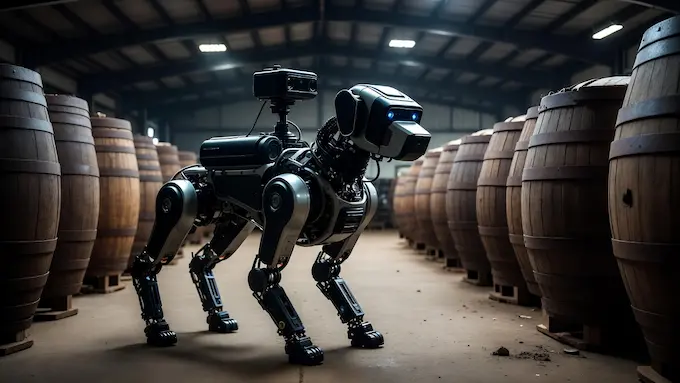
Bacardi’s “Royal Bark-la” patrols maturation warehouses for ethanol loss
At John Dewar & Sons’ Scotch whisky maturation site, drinks giant Bacardi has introduced a four-legged robot dog nicknamed “Royal Bark-la” to monitor warehouses for ethanol leaks. The pilot, described as a first for the Scotch industry, aims to detect small but costly losses beyond the expected “Angel’s Share” evaporation that occurs during aging. (Food and Drink Technology)
Equipped with sensors and autonomous navigation, the robot dog roams among stacked casks, scanning for anomalies that might signal leaks before they become significant. With evaporation across the industry already equal to around 440,000 casks a year, even modest gains in leak detection could translate into substantial savings. (Food and Drink Technology)
It’s an unusual but telling example in weekly robotics news of how mobile robots are moving into heritage industries, combining centuries-old craftsmanship with modern inspection tools.
- Key points:
- Bacardi is trialling a robot dog at a Scotch maturation site.
- The robot autonomously searches for ethanol leaks among casks.
- Reducing unexpected losses could save significant product and revenue.
10. Microrobots the size of a hair could one day save lives
Penn and Michigan team build fully autonomous robots just 200 micrometers wide | Weekly Robotics News | The Bolt and the Byte
Scientists at the University of Pennsylvania and the University of Michigan have developed what they describe as the world’s smallest autonomous, programmable robots—about 200 micrometers across, roughly twice the width of a human hair. Each microrobot carries its own tiny computer, memory and sensors on a chip less than a millimeter wide, powered by light via minuscule solar panels. (New Atlas)
Operating in a hydrogen peroxide solution, the robots generate electric fields that move ions and drag water molecules to propel themselves, with enough control to navigate complex trajectories and coordinate as swarms. Researchers say these microrobots could eventually monitor individual cells or deliver drugs inside the body, though biocompatible actuators and safer propulsion media are still needed. (New Atlas)
Among this week’s weekly robotics news items, these tiny machines showcase a future where “robots” may be invisible to the naked eye yet fundamental to healthcare and manufacturing.
- Key points:
- Microrobots are ~200 µm wide and fully autonomous.
- On-board microcomputers and sensors run on extremely low power.
- Potential uses include cell-level monitoring and precision drug delivery.
11. Ukraine approves grenade-launching ground combat robot
DevDroid’s Droid NW 40 joins a growing fleet of unmanned ground vehicles
Ukrainian defense officials have codified DevDroid’s Droid NW 40, a tracked unmanned ground vehicle adapted to carry two key automatic grenade launchers: the US-made Mk-19 and the Ukrainian-made AGL-53. The company says it is the first reconnaissance and strike UGV in the country officially adapted for both systems. (Business Insider)
Ground robots are increasingly used in Ukraine to offset manpower disadvantages—performing roles from direct fire support and demolitions to casualty evacuation. Devices like Droid NW 40 extend the reach of troops while keeping human operators further from the front line, raising fresh debates in weekly robotics news about autonomy, escalation and the future of land warfare. (Business Insider)
- Key points:
- Droid NW 40 is approved to carry Mk-19 and AGL-53 grenade launchers.
- UGVs take on firing, demolition and evacuation tasks in Ukraine.
Official codification suggests growing institutional acceptance of combat robots
12. Global humanoid street dance competition debuts in Guangxi
Sixteen teams to showcase dancing robots from leading manufacturers | Weekly Robotics News | The Bolt and the Byte
Guangxi in southern China will host the 2025 First Global Humanoid Robot Street Dance Invitational on December 27, bringing together 16 teams from cities such as Shanghai, Hangzhou, Nanning and Guilin as well as participants from Italy, Malaysia, Vietnam, Burkina Faso and Sierra Leone. (People’s Daily Online)
Teams will compete using humanoid robots from leading manufacturers including Unitree Robotics, Zhiyuan Robotics, Booster Robotics, EngineAI, LimX Dynamics and Noetix Robotics. Organizers say the event is designed to highlight advances in balance, motion control and choreography while making cutting-edge robotics more accessible to the public. (People’s Daily Online)
In the context of weekly robotics news, a dedicated dance competition underlines just how quickly humanoids are becoming platforms for culture, entertainment and international soft power.
- Key points:
- First global humanoid street dance event takes place in Guangxi on Dec. 27.
- 16 teams from China and abroad will compete.
Robots from multiple leading Chinese humanoid makers will be featured
13. Vbot’s AI robot dog sells 1,000 units in 52 minutes
Surging demand hints at a breakthrough for consumer embodied intelligence | Weekly Robotics News | The Bolt and the Byte
Chinese startup Vita Dynamics (Vbot) reports that its AI-powered robot dog sold over 1,000 units within 52 minutes of launch, setting a sales record for five-figure-priced embodied AI products. Sold at an early-bird price of RMB 9,988 (around USD 1,368), the quadruped uses 128 TOPS of on-device AI compute, LiDAR and depth vision, processing all visuals locally to preserve privacy. (Pandaily)
The robot can tow up to 100 kg, run for around five hours and recharge via wireless pads or 240 W USB-C fast charging. Its architecture draws heavily from smart electric vehicles, featuring distinct “spatial intelligence” and “interactive cockpit” systems. Early sales and social media buzz suggest strong consumer appetite, making Vbot a closely watched example in weekly robotics news of what mass-market embodied AI might look like. (Pandaily)
- Key points:
- 1,000 units sold in 52 minutes after launch.
- 128 TOPS on-device AI with LiDAR and depth vision.
EV-inspired architecture separates navigation and human interaction systems
14. Europol warns of rising crimes involving robots and drones
From narco-submarines to smuggling drones, autonomous systems pose new risks
A Europol report highlighted in AS USA warns that crimes involving drones, autonomous vehicles and other unmanned systems are increasing, with tactics from modern warfare spilling into organized crime and terrorism. Examples include unmanned underwater “narco submarines” equipped with satellite connectivity, as well as drones used for surveillance and smuggling across Europe’s borders. (AS USA)
The agency stresses that remote operation can turn “crime-as-a-service” into “crime-at-a-distance,” making it harder to identify those responsible. It also raises hard questions around liability when autonomous vehicles or robots injure people: was it malfunction, poor oversight or deliberate abuse? For weekly robotics news, the report is a reminder that as robots scale into everyday life, governance, security and law must evolve just as quickly. (AS USA)
- Key points:
- Europol sees 2022 as a turning point for criminal use of unmanned systems.
- Drones and underwater vehicles are used for surveillance and smuggling.
- Legal responsibility for autonomous incidents remains a major concern.
15. Investors circle robotics firms in China’s secondary markets
Capital board lists deals for Zhiyuan Robot and other deep-tech players | The Bolt and the Byte
A recent Capital Information Message Board on 36Kr details multiple transactions for old shares and fund LP interests in advanced technology firms, including a fund holding stakes in Zhiyuan Robot, valued at around RMB 25 billion. The notice outlines potential transfers of 10–20 million shares via two-tier LP structures, alongside deals for chipmakers, solid-state battery firms and AI companies. (36Kr)
While the document reads like a deal sheet rather than product news, it points to strong investor appetite for robotics and adjacent technologies in China’s private markets. For followers of weekly robotics news, it’s a reminder that behind every flashy product demo and competition, there’s a capital stack of funds and secondary trades powering the robotics boom. (36Kr)
- Key points:
- 36Kr board lists secondary deals in deep-tech companies.
- One LP stake involves Zhiyuan Robot, valued near RMB 25 billion.
Activity shows sustained investor interest in robotics and AI infrastructure
Community FAQs
Q1: Are robot dogs actually useful at home or are they just expensive toys?
Most buyers treat them like advanced smart devices; usefulness grows with apps & add-ons. Early adopters say they’re fun, but mass adoption depends on reliability and cost.
Q2: How close are we to having a “real maid robot” that folds laundry?
We’re closer than ever — benchmarks like Robot Olympics show progress — but full autonomy across unpredictable tasks is still ~3–7 years away.
Q3: Why are humanoid robots suddenly everywhere in news feeds?
Advances in balance control + cheaper actuators + transformer-based control models = exponential progress. Investors expect humanoids to fit human spaces without retrofitting.
Q4: Should we be worried about robots being weaponized?
Military deployment is happening now. Ethical use depends on oversight and transparency. Most researchers push for “human-in-the-loop” control for lethal tasks.
Q5: Microrobots seem scary — could they be misused?
In theory yes, but in practice propulsion & safety barriers make misuse extremely difficult today. Current prototypes need lab conditions and can’t operate freely in the body yet.
Q6: What happens to jobs when home robots go mainstream?
History says automation shifts jobs, not erases work. Maintenance, design & new services grow, but repetitive labor shrinks — similar to what tractors did to farming.
Conclusion
As 2025 closes, robotics is no longer defined by factories alone it’s reshaping homes, entertainment, agriculture, medicine, defense and even heritage industries like whisky production. This week’s developments show that humanoids are stepping onto stages, microrobots are preparing for work inside the human body, robot dogs are testing consumer demand and autonomous systems are raising urgent legal and ethical questions.
If weekly robotics news once meant industrial automation, it now reflects society, culture, fear, hope and the future of work itself.
The next breakthroughs will be defined not just by what robots can do, but where and how we choose to use them.



