
Table of Contents
Pudu’s D5 Quadruped Steps Into Rugged Outdoor Work
Four-legged D5 platform targets inspections, patrols and complex sites | Weekly Robotics News | The Bolt and the Byte
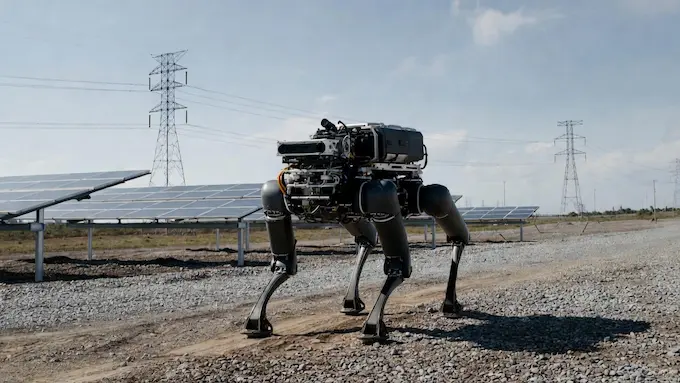
Pudu Robotics, best known for its indoor service robots, has launched a new D5 quadruped platform designed for outdoor and industrial environments. The D5 series includes versions focused on rough terrain and hybrid leg-plus-wheel mobility for tasks like inspection, patrol and light logistics. PR Newswire
By combining four-legged locomotion with advanced sensing and autonomous navigation, the D5 is meant to work in spaces that are too uneven or hazardous for typical wheeled robots. From energy facilities to campuses, the company is pitching the platform as a general-purpose, “embodied intelligence” worker that can run persistent missions with minimal supervision.
For readers following weekly robotics news, this launch underscores how quadrupeds are moving beyond lab demos into real infrastructure roles, sitting alongside drones and fixed cameras as part of a wider automation stack.
Key points:
- Pudu introduces the D5 quadruped robot family for outdoor use.
- Focus on inspection, patrol and logistics across complex terrain.
- Hybrid leg-and-wheel option broadens the range of possible deployments.
China Mobile Unveils “Lingxi,” Its First Consumer Quadruped Robot
Telecom giant steps into home robotics with an embodied AI companion | Weekly Robotics News | The Bolt and the Byte
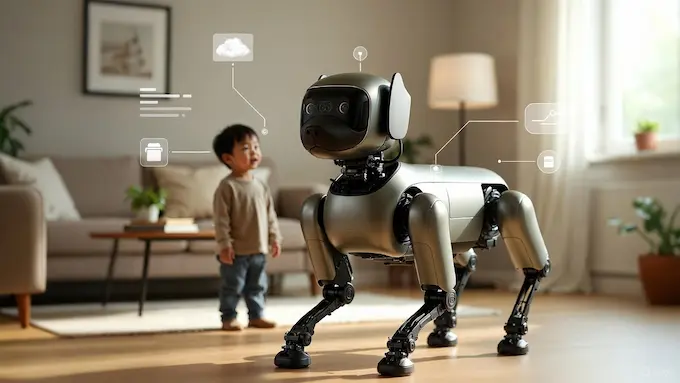
China Mobile has introduced “Lingxi,” billed as its first consumer-grade quadruped robot aimed at families rather than factories. The four-legged machine combines a pet-like form factor with large-model AI, supporting conversational interaction, home patrol and educational content for children. AIBase
Lingxi is positioned as a new kind of service node in China Mobile’s ecosystem, tying into cloud services and smart-home platforms. The robot can act as a moving camera and assistant, potentially supporting elder care, security alerts and remote check-ins from family members.
In the broader context of weekly robotics news, Lingxi signals how telecom operators see embodied AI as another endpoint on their networks, extending beyond smartphones and set-top boxes into mobile home robots.
Key points:
- China Mobile launches “Lingxi,” a consumer quadruped robot.
- Designed for companionship, education, basic home security and remote monitoring.
- Integrates with cloud AI and smart-home services.
Hyundai’s MobED Robot Rolls Toward Real-World Jobs
Skateboard-style platform blends automotive engineering with AI navigation | The Bolt and the Byte
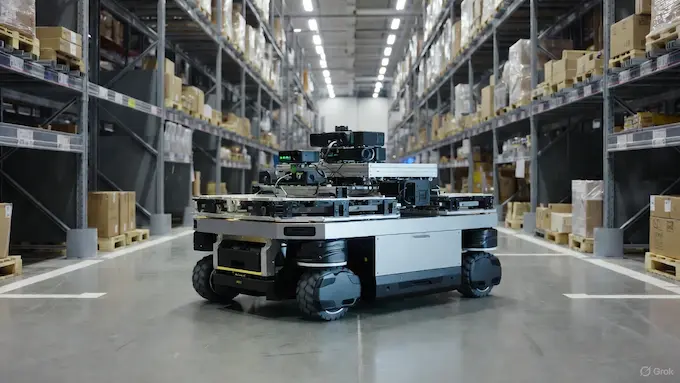
Hyundai Motor Group has reintroduced its MobED robot, this time as a production-ready platform at the International Robot Exhibition in Tokyo. The compact, skateboard-like base uses an adaptive posture system to keep the platform level while driving over slopes, bumps and uneven surfaces. Autoweek
MobED is powered by an AI navigation stack that fuses LiDAR and camera data, allowing it to map its surroundings, avoid obstacles and plan efficient routes. Hyundai plans two versions: a Pro model with full autonomy and a Basic version aimed at developers who want to build custom applications.
The company sees MobED as a flexible chassis for delivery, logistics, research and media work, extending its robotics ambitions beyond humanoids into practical rolling platforms that can be tailored to niche tasks.
Key points:
- MobED is a small mobile base with advanced posture control and AI navigation.
- Two variants: a fully autonomous Pro and a developer-focused Basic.
- Targeted at logistics, delivery, research and creative applications.
MIT’s Bumblebee-Style Microrobot Pushes Insect-Scale Flight Forward
Tiny flier shows agile, fast flight in a lab setting | Weekly Robotics News | The Bolt and the Byte
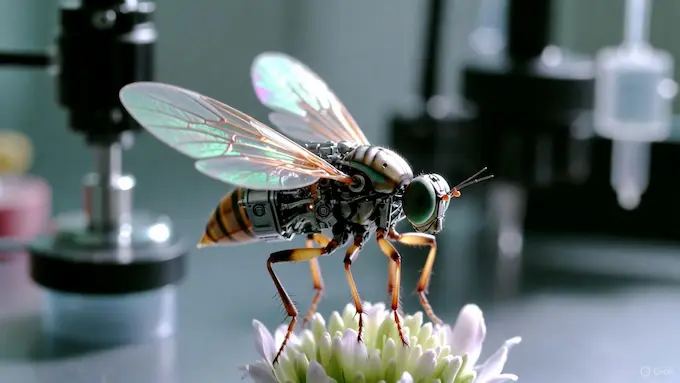
MIT engineers have designed an insect-scale aerial microrobot that can fly with speed and agility comparable to a real bumblebee. The prototype uses ultralight actuators and a new control strategy to maintain stable flight even in turbulent air, a long-standing challenge in tiny drones. MIT News+1
The microrobot’s wings beat rapidly while sensors and control algorithms continuously adjust its motion, allowing sharp turns and quick recovery when hit by gusts. While still a lab platform tethered to external power in many experiments, the work shows that controllable, fast insect-like flight is possible at this scale.
For weekly robotics news watchers, the project hints at future microrobots that could carry out pollination, environmental monitoring or indoor inspection missions where larger drones are too risky or noisy.
Key points:
- MIT’s microrobot mimics bumblebee-like flight agility.
- Robust control helps it withstand wind gusts and turbulence.
- Long-term applications include pollination and delicate inspection tasks.
Surgical Robotics Aims for ‘Superhuman’ and Remote Operations
Industry leaders talk about operating rooms where distance doesn’t matter | The Bolt and the Byte
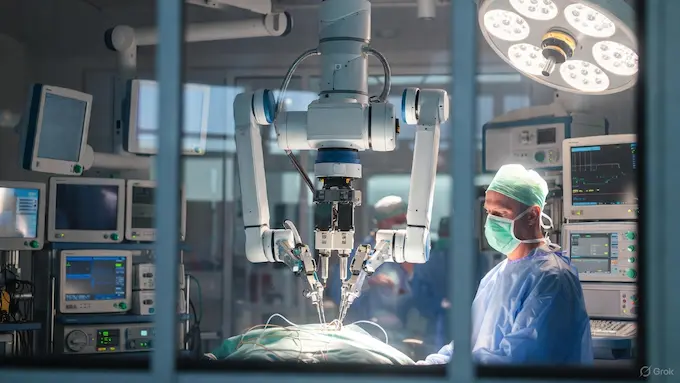
In a recent interview, surgical robotics executive David Fischel discussed how robot-assisted procedures are evolving from simple mechanical aids into platforms that can enable “superhuman” precision and remote operations. His company’s systems use magnetic navigation and robotic control to guide instruments deep inside the body with millimetre-scale accuracy. 36Kr
The long-term vision is operating rooms where the surgeon may not even be on site. Instead, specialists could supervise procedures from a central hub, using robotics, imaging and networked control to treat patients in remote or underserved hospitals. That could help spread access to advanced therapies while reducing radiation exposure and physical strain on physicians.
As part of this week’s robotics news cycle, surgical robotics shows how physical AI is not just about factories and warehouses, but also about extending human capability and reach in high-stakes medical environments.
Key points:
- Surgical robots are moving toward more precise and fully remote procedures.
- Magnetic navigation and robotics can reduce strain and radiation exposure for clinicians.
- Remote operation could expand access to specialist care.
Humanoid Robot Wows Crowd With Live Onstage AI Performance
Demo blends real-time conversation, emotion reading and choreography | Weekly Robotics News | The Bolt and the Byte
A recent live event covered by Fox News’ AI desk and Blockchain.News featured a humanoid robot delivering a surprisingly fluid onstage performance. The robot held unscripted conversations, responded to audience emotions and executed complex movements in real time, powered by an onboard AI system rather than pre-recorded lines. Blockchain News
Commentators highlighted the demonstration as a milestone in human-robot interaction, showing how generative AI models and multimodal sensing can be embedded directly into physical platforms. The robot’s ability to improvise jokes, adapt to audience reactions and maintain natural timing drew particular attention.
For weekly robotics news readers, this kind of embodied AI performance points toward new roles for humanoids in entertainment, live events and customer service—while raising fresh questions about safety, ethics and expectations around lifelike machines.
Key points:
- A humanoid robot performed a live, emotionally-aware show on stage.
- The system combined conversational AI with movement and gesture control.
- Use cases range from entertainment to high-visibility customer engagement.
RLWRLD CEO: Physical AI Is Key to Solving Korea’s Labor Crunch
AWS re:Invent panel links humanoids and foundation models to factory survival | The Bolt and the Byte
At AWS re:Invent 2025, RLWRLD CEO Ryu Jung-hee argued that “physical AI” robotics will be essential for manufacturing economies like Korea and Japan as they confront shrinking workforces. Speaking on a panel alongside AWS and Nvidia leaders, he warned that major industrial customers fear losing core businesses if they fail to automate within the next five years. Korea Times
RLWRLD is collecting detailed 4D motion data from workers in real factories and logistics sites, which it uses to train robot foundation models that can transfer skills to multiple humanoid and robotic platforms. Ryu contrasted this approach with text-only large language models, stressing that physical AI must obey the laws of physics and strict safety requirements.
For weekly robotics news, the message is clear: physical AI and humanoid robots are being framed not as distant sci-fi, but as urgent tools for keeping aging industrial economies productive.
Key points:
- RLWRLD sees physical AI as a solution to severe labor shortages in Northeast Asia.
- The company trains robot models using captured motion data from real workers.
- Industrial stakeholders worry about competitiveness if automation lags.
Mobile Manipulators Become the Hottest Segment in Industrial Robotics
Arms-on-wheels and humanoids ride AI wave into factories and warehouses | Weekly Robotics News | The Bolt and the Byte
A detailed industry insight from the Association for Advancing Automation (A3) describes mobile manipulators—robot arms mounted on mobile bases and often guided by AI—as one of the fastest-growing segments in the robot market. Executives from Plus One Robotics, Mobile Industrial Robots and Apptronik say labor shortages and better perception systems are pushing demand. Automate
These systems merge the mobility of autonomous mobile robots with the dexterity of manipulators, enabling tasks like truck unloading, kitting, machine tending and hospital logistics. The article also links humanoid robots to the same trend, treating legged or wheeled humanoids as another flavor of mobile manipulator with bimanual arms and a vertically integrated stack.
Morgan Stanley estimates that the humanoid subset alone could represent a multi-trillion-dollar market by mid-century if deployments scale, though experts caution that integration complexity and workforce acceptance remain major hurdles.
Key points:
- Mobile manipulators combine AMRs with robot arms and AI control.
- They’re gaining traction in logistics, manufacturing and healthcare.
- Humanoids are framed as a related, high-growth category in the same trend.
Korean Researchers Pilot Precision Agriculture With Field Robots and Drones
ETRI’s smart-farm project brings AI and robotics to rural land | The Bolt and the Byte
South Korea’s Electronics and Telecommunications Research Institute (ETRI) is preparing a precision-agriculture pilot that uses robots and AI to manage crops in a rural county. The project combines autonomous field equipment and sensing systems to monitor plant health, apply fertilizer and support farmers with data-driven decisions. N/A
By integrating robotics with mapping and analytics, the system aims to reduce labor demands while raising yields and cutting resource use. Robots can handle repetitive tasks such as spraying or weeding, while drones and sensors detect issues before they become visible to the human eye.
Within this week’s robotics news, smart-farm pilots like ETRI’s show how physical AI is spreading beyond factories and warehouses into agriculture, where climate pressure and rural depopulation are forcing new automation strategies.
Key points:
- ETRI is deploying robots and AI to support precision farming in South Korea.
- Field robots and drones help monitor crops and automate repetitive work.
- Goals include higher productivity and lower resource use in aging rural regions.
New MH370 Search Will Lean on Deep-Sea Robotics
Autonomous underwater vehicles prepare for another look at the Indian Ocean | Weekly Robotics News | The Bolt and the Byte
Malaysia has signaled support for a renewed search for missing flight MH370, and the latest proposals center on fleets of deep-sea robots. A Scientific American report describes plans for autonomous underwater vehicles and uncrewed surface vessels to scan a refined section of the Indian Ocean seabed using sonar and advanced mapping software.
Unlike earlier missions, the new approach would use more autonomous surveying, allowing robots to cover large swathes of rugged terrain with minimal direct control. Improved data processing could also help analysts sift through sonar images faster to spot possible wreckage.
For readers of weekly robotics news, the MH370 effort highlights how ocean-exploration robotics has matured into a core tool for solving long-standing mysteries, as well as for inspecting cables, pipelines and remote seabed infrastructure.
Key points:
- Authorities are considering a renewed MH370 search using deep-sea robots.
- AUVs and uncrewed surface vessels would map the seabed autonomously.
- Similar technology underpins broader ocean-inspection and survey work.
Richtech Robotics Stock Soars on Policy Buzz and Physical-AI Hype
White House talk and AI deals send service-robot shares sharply higher | Weekly Robotics News | The Bolt and the Byte
Service-robot maker Richtech Robotics saw its stock jump nearly 19% in a single session after reports that the White House is considering an executive-order framework to support U.S. robotics and automation. A detailed recap from TS2.Tech links the spike to broader enthusiasm for robots focused on hospitality, cleaning and light industrial work, not just traditional factory arms. TechStock²
The article notes that Richtech’s valuation has run ahead of its still-modest revenue, and that the company has expanded its authorized share count significantly—raising dilution concerns even as analysts discuss Robotics-as-a-Service (RaaS) and high gross margins as bullish factors. With short interest elevated, RR has effectively become a high-beta way to bet on U.S. robotics sentiment.
This week’s market action shows how quickly policy chatter and physical-AI narratives can move small-cap robotics names, even when fundamentals remain volatile.
Key points:
- Richtech Robotics stock surged on speculation about U.S. robotics policy support.
- The company focuses on service robots and a RaaS model.
- Analysts see both strong potential and significant dilution and volatility risks.
Dex and ADAM: Richtech’s Physical-AI Robots Head to Arenas and Shop Floors
Humanoid Dex and bartender ADAM test real-world roles and data strategies | The Bolt and the Byte
Beyond its stock price, Richtech Robotics has been busy rolling out new hardware. TS2.Tech highlights Dex, a wheeled humanoid robot powered by Nvidia Jetson hardware and trained in simulation, designed for machine tending, material handling and quality inspection. The company is also pushing its ADAM bartender and barista robots into venues such as the Vegas Golden Knights’ home arena for high-profile deployments. TechStock²
These pilots are as much about data as about novelty. Richtech is collecting detailed operational logs from Dex and ADAM and partnering with NomadGo to integrate inventory AI, aiming to build closed-loop systems that can see stock levels, place orders and restock autonomously. If successful, that would support the company’s shift to recurring RaaS contracts built around performance rather than one-off hardware sales.
In weekly robotics news terms, Dex and ADAM illustrate how service-robot vendors are trying to turn physical robots plus data pipelines into long-term platforms rather than just gadgets.
Key points:
- Dex is a wheeled humanoid targeting light industrial tasks.
- ADAM bartender robots are appearing at a major sports venue in Las Vegas.
- Richtech is pairing robots with inventory AI and a RaaS business model.
China Sounds Alarm Over a Potential ‘Robotics Bubble’
Officials warn of overheating even as industrial policy backs robots | Weekly Robotics News | The Bolt and the Byte
A Futurism report notes that Chinese state-linked commentators have begun warning about a potential “robotics bubble,” citing surging valuations and aggressive local investment in robot makers and suppliers. Concerns center on speculative capital chasing copy-cat projects and the risk of overcapacity if too many similar platforms hit the market at once. NVIDIA Blog
At the same time, Beijing’s long-term industrial strategy still calls for heavy investment in automation and embodied AI. The tension between strategic support and bubble risk mirrors earlier cycles in solar, EVs and the internet sector, where the country ultimately emerged as a manufacturing powerhouse but endured painful shake-outs.
For weekly robotics news, China’s stance matters globally: its appetite for industrial robots, humanoids and components will influence pricing, competition and supply chains far beyond its borders.
Key points:
- Chinese commentators are warning about a possible robotics investment bubble.
- Overlapping robot projects and high valuations are key concerns.
- Despite worries, long-term policy still favors heavy automation investment.
Tesla Talent Flows to Sunday Robotics and Its Memo Home Robot
Ex-Optimus and Autopilot engineers bet on a domestic assistant | Weekly Robotics News | The Bolt and the Byte
Business Insider reports that Sunday Robotics, a young startup, has hired at least ten former Tesla employees many with experience on the company’s Optimus humanoid and Autopilot programs to work on a new home robot called Memo. The team includes engineers who helped build AI infrastructure and motion planning for Tesla’s high-profile robotics efforts. Business Insider
Sunday Robotics recently unveiled Memo along with ACT-1, a robot foundation model that the company says was trained without direct robot data but can generalize across long-horizon household tasks. A demo video shows Memo loading dishwashers, handling glassware and folding laundry, positioning it as a general domestic assistant rather than a single-function appliance.
In weekly robotics news, the shift of seasoned Tesla talent into Memo underscores how quickly the home-robot field is heating up, with startups betting that learned manipulation skills and foundation models will unlock a new consumer category.
Key points:
- Sunday Robotics has recruited multiple former Tesla Optimus and Autopilot engineers.
- Its Memo robot targets household chores using a foundation model called ACT-1.
- The move highlights intensifying competition in advanced home robotics.
Nvidia Pushes Open-Source ‘Digital and Physical AI’ at NeurIPS
New tools aim to connect robot learning, simulation and real-world deployment | The Bolt and the Byte
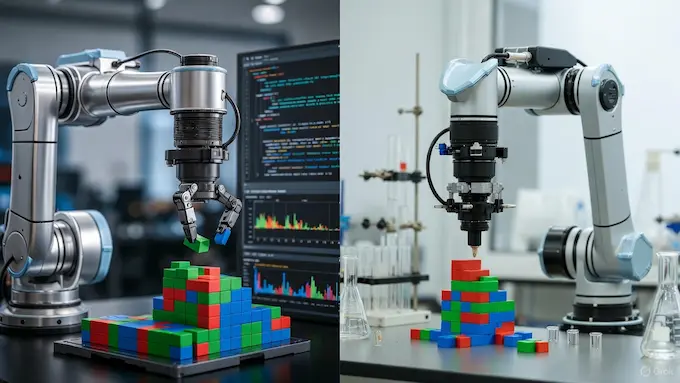
Nvidia’s NeurIPS 2025 blog highlights a wave of open-source releases aimed at what the company calls “digital and physical AI”—systems that can live both as simulation agents and as controllers for real robots. The update showcases model libraries, reference workflows and developer tools designed to make it easier for research teams to train robots in virtual environments and then transfer skills to hardware. NVIDIA Blog
By open-sourcing more of its stacks around simulation, perception and policy learning, Nvidia is trying to standardize pieces of the robotics pipeline across universities and startups. That, in turn, could accelerate experimentation with mobile manipulators, humanoids and field robots built on Jetson-class hardware and cloud GPUs.
For weekly robotics news audiences, the NeurIPS push is a reminder that many of the biggest breakthroughs in physical robots now depend as much on shared software ecosystems as on mechanical Short subheading: New tools aim to connect robot learning, simulation and real-world deployment | The Bolt and the Byte innovation.
Key points:
- Nvidia is releasing more open-source tools for “digital and physical AI.”
- The focus is on training in simulation and transferring to real robots.
- Shared stacks could speed up robotics research and startup development.
Conclusion
From factory floors and sports arenas to family kitchens and the deep ocean, robots are quietly taking on more real-world work every week. This edition’s stories show how physical AI, better hardware and shared software tools are turning ambitious prototypes into practical systems that people will soon encounter in everyday life.
Q1. What is the main theme of this week’s robotics developments?
Most of this week’s stories point to one big trend: robots are moving out of carefully controlled pilot projects and into messy, real environments. We see quadrupeds for outdoor inspection, home robots tackling chores, and deep-sea vehicles preparing for another MH370 search. Together, they show how quickly physical AI is leaving the lab and entering daily life.
Q2. Why are quadruped robots getting so much attention right now?
Quadruped robots can handle rough ground, steps and uneven terrain that defeat many wheeled machines, which makes them attractive for inspections, patrols and outdoor logistics. As prices fall and AI perception improves, governments and companies see them as a flexible way to cover more ground with fewer people. That’s why they feature so prominently in this weekly robotics news roundup.
Q3. How are humanoid and mobile manipulator robots changing factories and warehouses?
Humanoids and mobile manipulators combine advanced arms with navigation, so they can move through existing layouts instead of demanding fully redesigned facilities. Companies are testing them on jobs like truck unloading, machine tending and kitting, where human workers are hard to hire or retain. If these trials scale up, they could reshape how industrial sites plan their workforce and floor space.
Q4. What role does ‘physical AI’ play in solving labor shortages?
Physical AI refers to AI systems embodied in real machines that can sense, move and manipulate the world. In aging economies, leaders see it as a way to keep factories, farms and hospitals running despite shrinking labor pools. By capturing how humans perform tasks and training robot foundation models, companies hope to deploy fleets of machines that can safely share workloads with human teams.
Q5. Are home and service robots close to mainstream adoption?
Home and service robots are still early, but the pieces are coming together: better manipulation, more robust navigation and foundation models that can generalize across many tasks. Startups are focusing on narrow, high-value roles—such as barista robots in arenas or domestic helpers for repetitive chores—to prove reliability and economics. As deployments grow and costs drop, readers can expect future weekly robotics news editions to track how these systems move from novelty to necessity.



