
Table of Contents
1. Wearable walking-assist robot WIM S heads to CES 2026
| Weekly Robotics News | The Bolt and the Byte
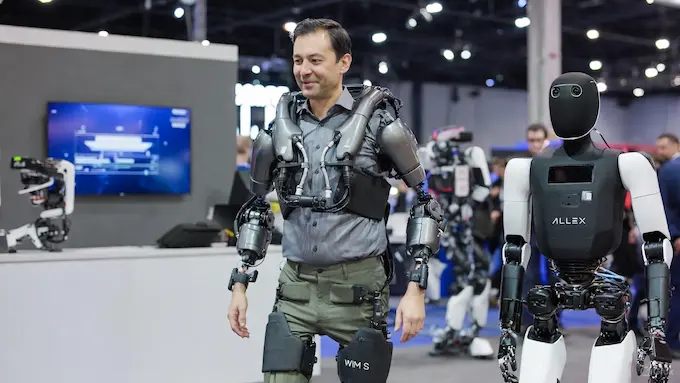
WIRobotics will bring its wearable walking-assist robot WIM S to CES 2026 Unveiled in Las Vegas on January 4, offering visitors a chance to strap it on and walk with it themselves.
The device is part of the company’s WIM series, already used by seniors, people with limited mobility, and workers who need musculoskeletal support across Korea, mainland China, Japan, Italy and the Netherlands. The new S model is lighter and more compact, designed to improve comfort and portability while still providing responsive assistance.
WIM S supports four walking modes—Air, Hiking, Care, and Aqua—so the same hardware can be tuned from everyday mobility to more demanding exercise or rehabilitation scenarios. WIRobotics is also teasing the first global appearance of its humanoid robot ALLEX, underscoring how assistive exoskeletons and humanoids are converging as a theme in this weekly robotics news cycle.
Key points
- WIM S is a wearable walking-assist robot for mobility support
- Hands-on demos planned at CES 2026 Unveiled in Las Vegas
- Lighter, more compact design with four specialized walking modes
- Part of a broader WIM series used across Asia and Europe
2. AI-powered robotic dog trained for disaster response

Smart four-legged first responder | Weekly Robotics News | The Bolt and the Byte
At Texas A&M University, engineering students have built an AI-powered robotic dog designed for search-and-rescue and other emergency missions. The four-legged machine uses a multimodal large language model (MLLM) to “see,” remember environments, and interpret voice commands, turning natural language into navigation and task decisions.
Rather than simply following waypoints, the robot blends visual memory, mapping and high-level reasoning. It can recall previously traveled paths to move more efficiently through rubble or unfamiliar structures, which is valuable in unmapped or GPS-denied disaster zones.
The team envisions the platform as a flexible tool: from disaster response to hospital logistics, large facilities, and even assistance for people with visual impairments. For readers following weekly robotics news, this project hints at how on-device foundation models could make field robots more autonomous and collaborative.
Key points
- Robotic dog uses an MLLM for memory-driven visual navigation
- Understands voice commands and uses onboard cameras to plan routes
- Designed for search-and-rescue but extensible to hospitals, warehouses and more
- Demonstrated at the International Conference on Ubiquitous Robots
3. Agility’s Digit humanoid joins Mercado Libre in Texas
Humanoids step into e-commerce warehouses | Weekly Robotics News | The Bolt and the Byte
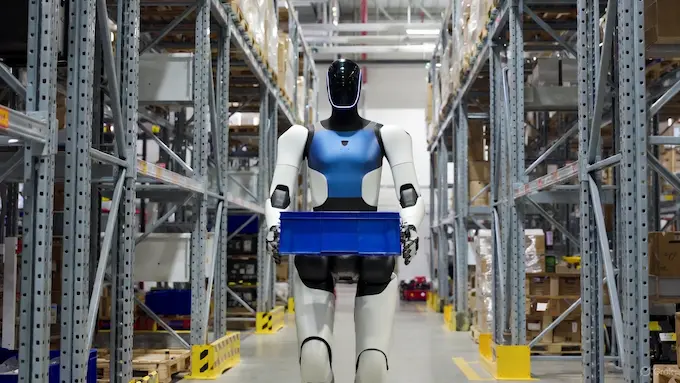
Agility Robotics has begun deploying its Digit humanoid robot into a Mercado Libre fulfillment center in San Antonio, Texas, as part of a broader commercial agreement between the two companies.
Digit will start with tote-handling and other repetitive e-commerce tasks, walking standard warehouse aisles and moving items without requiring expensive layout changes. Agility says the robot has already moved more than 100,000 totes in commercial operations, and Mercado Libre plans to explore expansion to facilities across Latin America if the pilot goes well.
For Mercado Libre, the aim is not just productivity but ergonomics—offloading physically taxing, hard-to-hire-for roles to robots while letting human staff concentrate on higher-value work. It’s a concrete example of humanoids moving from glossy demos into routine logistics, and a headline item in weekly robotics news about warehouse automation.
Key points
- Digit humanoid robot deployed in Mercado Libre’s San Antonio fulfillment center
- Initial focus: tote movement and repetitive logistics tasks
- Commercial agreement includes options for broader Latin American rollout
- Goal: improve ergonomics, fill labor gaps, and boost throughput
4. Roborock’s Qrevo Curv 2 Flow debuts roller mopping robot
High-pressure cleaning for homes | Weekly Robotics News | The Bolt and the Byte
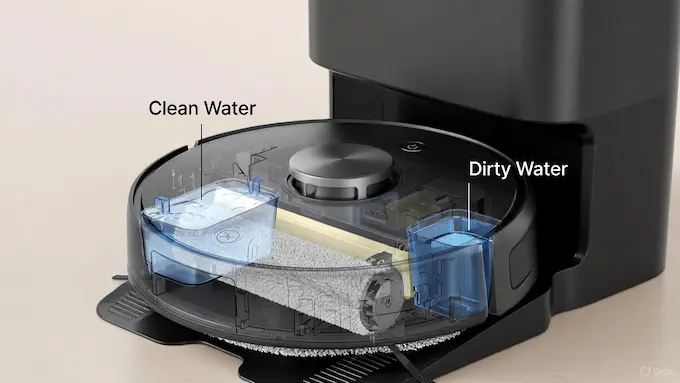
Roborock has introduced the Qrevo Curv 2 Flow, its first robot vacuum with a full-width roller mop instead of spinning pads. The 270 mm roller spins at 220 RPM, uses eight nozzles to continuously feed clean water, and scrapes dirty water into a separate tank to avoid cross-contamination.
The robot automatically lifts the roller by 15 mm when it detects carpet, shielding rugs from moisture. On the vacuuming side, a new DuoDivide anti-tangle brush system uses dual side brushes to funnel hair into the center, helping achieve near-zero hair wrapping in testing—particularly appealing for pet owners.
A redesigned dock washes the roller with 75°C hot water and dries it with warm air to prevent mildew and odors, while Roborock’s Reactive AI system combines LiDAR and structured-light sensing to recognize over 200 household obstacles. The Qrevo Curv 2 Flow reflects how consumer robotics is blending higher autonomy with serious attention to hygiene and cybersecurity standards.
Key points
- First Roborock model with a full-width high-speed roller mop
- Auto-lifts mop when crossing carpets to keep them dry
- DuoDivide brush design targets zero hair wrapping
- Dock uses hot water wash and warm-air drying to reduce odors
5. China’s MIRO U and Pudu D5 showcase multi-limbed robots
Six arms, four legs, and a booming ecosystem | Weekly Robotics News | The Bolt and the Byte
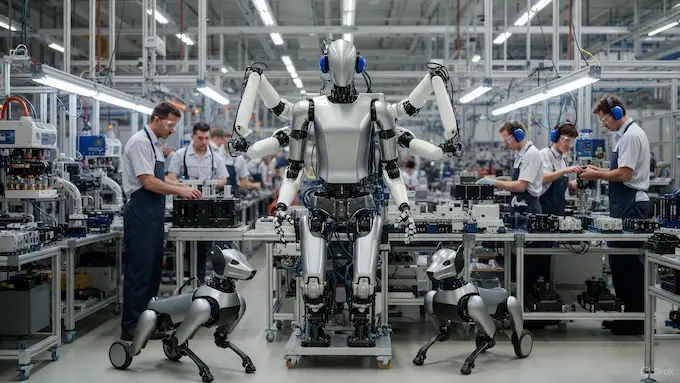
Chinese home appliance giant Midea Group has unveiled MIRO U, a six-armed humanoid robot designed for factory deployment starting at a washing-machine plant in Wuxi. The system is expected to boost line efficiency by around 30%, using six coordinated arms mounted on a wheeled base that can pivot in place and perform vertical lifting tasks.
At the same time, service-robot maker Pudu Robotics showed its four-legged D5 robot dog at a Tokyo expo. The D5 walks down steps, switches onto wheels to roll around, and uses an Nvidia Orin chip, fisheye cameras and dual LiDAR to navigate autonomously. Pudu sees potential from inspection and delivery to customized industrial functions.
These launches sit within a broader Chinese robot “boom,” with companies racing to showcase humanoids, quadrupeds and hybrid platforms while investors and regulators debate whether a bubble is forming. For weekly robotics news watchers, MIRO U and D5 illustrate how multi-limbed designs are moving quickly from concept renderings to specific industrial and commercial deployments.
Key points
- Midea’s MIRO U uses six arms on a mobile base for factory work
- Initial deployment planned at a washing-machine plant in Wuxi
- Pudu’s D5 is a hybrid legged-and-wheeled robot dog with high-end sensing
- Chinese officials warn of potential over-heating in the humanoid sector
6. Deep Robotics secures US$70 million for quadrupeds and humanoids

Funding surge for China’s robot dog maker | Weekly Robotics News | The Bolt and the Byte
Hangzhou-based Deep Robotics has raised about 500 million yuan (US$70 million) from a group of Chinese investors including CMB International, China Asset Management and funds tied to China Telecom and China Unicom.
The company, known for its LYNX M20 logistics-focused quadruped and new humanoid platforms, plans to use the funding for R&D and to recruit top robotics talent. It is one of several “little dragon” robotics firms clustered in Hangzhou, alongside names like Unitree Robotics and DeepSeek.
Backers see robot dogs and humanoids as “intelligent assistants” for inspection, logistics and industrial work, even as regulators warn about overinvestment. This round is another signal to weekly robotics news readers that Chinese capital is pouring into mobile robots meant to operate in real, often messy environments, not just labs.
Key points
- Deep Robotics raises US$70 million from major Chinese investors
- Funds earmarked for R&D and talent recruitment
- Company builds quadruped logistics robots and humanoids
- Highlights sustained investor appetite for Chinese embodied AI startups
7. Autonomous delivery robots roll out across the Gulf

Last-mile bots go live in Dubai | Weekly Robotics News | The Bolt and the Byte
Yango Group, a global tech company, and GCC e-commerce heavyweight noon have announced a strategic partnership to deploy autonomous delivery robots across the Gulf Cooperation Council region, starting with noon Minutes deliveries in Dubai.
The partnership moves the robots from pilot trials into live commercial operations, with fleets expected to expand from Dubai to other Gulf cities over time. The systems are designed to navigate urban sidewalks and residential communities, bringing small orders to customers’ doors without human couriers.
For the e-commerce sector, robots promise tighter delivery windows and reduced last-mile costs, but they also raise questions about regulation, public acceptance and accessibility. As weekly robotics news continues to track robot deployments, the GCC is emerging as a real-world testbed for autonomous logistics at scale.
Key points
- Yango and noon partner to scale autonomous delivery robots in the GCC
- Noon Minutes deliveries in Dubai are the first live deployment
- Expansion to broader regional operations is planned
- Raises new questions on urban robot rules and customer experience
8. Your Chinese robot dog is ‘phoning home’ every five minutes
Security lab flags serious Unitree vulnerabilities | Weekly Robotics News | The Bolt and the Byte
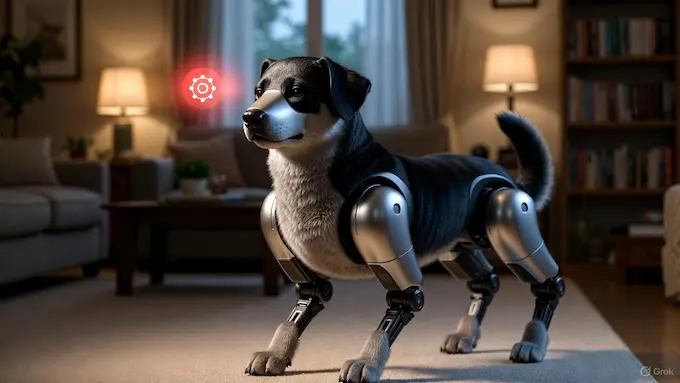
A report highlighted by Quasa describes security research from Cornell University’s Robotics and Security Lab into a consumer robot dog from Unitree Robotics. According to the write-up, the quadruped regularly connects back to cloud servers roughly every five minutes and suffers from multiple critical security design flaws.
Researchers reportedly showed that attackers could force-pair with the robot, push malicious firmware using a leaked private key shared across devices, and potentially turn the robot into a mobile surveillance node. The article warns that the robot can keep “phoning home” even when apparently powered off, by briefly waking on battery reserve.
For weekly robotics news readers, it’s a stark reminder that consumer robots are effectively roaming IoT endpoints: if cryptographic keys are hard-coded and update mechanisms are not secured, the risks go far beyond one household gadget.
Key points
- Unitree robot dog allegedly connects to cloud servers every few minutes
- Researchers claim they can silently push malicious firmware updates
- Shared private keys and weak authentication widen the attack surface
- Shows how home robot pets can become serious security liabilities
9. ‘Botnets in physical form’: humanoid robot security under scrutiny

Robots as the next big cyber-physical attack surface | Weekly Robotics News | The Bolt and the Byte
An analysis in The Register argues that the rise of humanoid and quadruped robots could create “botnets in a physical form” if security isn’t treated as a first-class design requirement. Citing forecasts of billions of robots in service by 2060, the report warns that compromised machines could move, see and listen in the real world, not just on a screen.
The piece highlights recent disclosures about vulnerabilities in Unitree robots, including hard-coded cryptographic keys and weak authentication on wireless interfaces that could allow worms to spread robot-to-robot. It likens future humanoid security businesses to “IoT on steroids,” with specialized firms emerging to harden robots used in factories, logistics and even homes.
For weekly robotics news, the takeaway is clear: as companies like Tesla, Toyota, Hyundai/Boston Dynamics, and various Chinese manufacturers race to deploy humanoids, security teams will need to think beyond servers and laptops and start threat-modeling fleets of mobile, sensor-rich machines.
Key points
- Analysts warn of “botnets in physical form” as robots proliferate
- Recent demos show how flawed robot designs can be fully hijacked
- Forecasts predict billions of humanoid and quadruped robots by 2060
- New security sub-industry for embodied AI is likely to emerge
10. EngineAI’s T800 kicks its own CEO to prove it’s real
Viral stunt blurs line between demo and danger | Weekly Robotics News | The Bolt and the Byte
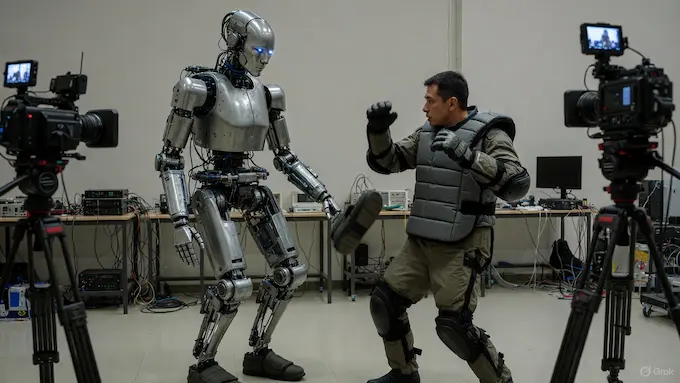
In one of the week’s most talked-about clips, EngineAI CEO Zhao Tongyang donned protective gear and allowed his company’s T800 humanoid robot to deliver a full-force kick to his torso. The video, posted after earlier action footage drew accusations of CGI fakery, shows the CEO knocked backward to the floor while exclaiming that the strike was “too brutal.”
Coverage notes that the demonstration may have been tele-operated or carefully staged, and that EngineAI has raised substantial funding while promising to deploy combat-capable humanoids. The stunt generated both awe and unease, feeding comparisons to robot boxing matches and raising questions about what kinds of capabilities the public actually wants from humanoids.
For weekly robotics news tracking the cultural side of robotics, the episode shows how viral marketing, safety optics and ethical concerns are increasingly intertwined—especially when robots are designed to hit, not help.
Key points
- EngineAI CEO takes a demonstrative kick from the T800 humanoid
- Video was meant to address skepticism about earlier high-action footage
- Debate continues over tele-operation vs autonomy in such demos
- Highlights growing interest in—and anxiety about—combat-style humanoids
11. Boston Dynamics’ WildCat reminds us robots once ran on gas
A 20 mph four-legged throwback | Weekly Robotics News | The Bolt and the Byte
A retrospective look at Boston Dynamics’ WildCat robot resurfaced this week, reminding viewers that long before sleek electric quadrupeds, the company fielded a roaring, gasoline-powered machine capable of sprinting at over 20 mph. Video footage shows the tetherless robot galloping across pavement and grass while sounding more like a chainsaw than a household gadget.
WildCat’s small fuel tank limited run time to just a few minutes, but the project demonstrated high-speed dynamic locomotion that influenced later designs like Spot and Atlas. The comparison with today’s battery-electric platforms underscores trade-offs between speed, endurance, noise and practicality as legged robots move closer to commercial use.
For weekly robotics news readers, it’s a reminder that the path to today’s polished showpieces runs through loud, experimental—and sometimes slightly terrifying—prototypes.
Key points
- WildCat was a gas-powered quadruped that could exceed 20 mph
- Extremely loud, with limited operating time due to small fuel tank
- Helped pioneer dynamic legged locomotion now seen in modern robots
- Highlights how far electric quadrupeds have come in refinement
12. Microscopic robots that ‘sense, think, act and compute’
Tiny machines aim for real autonomy | Weekly Robotics News | The Bolt and the Byte
A new paper in Science Robotics titled “Microscopic robots that sense, think, act, and compute” describes advances toward micrometer-scale robots integrating sensing, on-board computation and actuation.
Full technical details sit behind a journal paywall, but the title and abstract point to efforts to embed basic decision-making and control circuitry into microscopic devices rather than relying on external controllers. Such robots could eventually navigate inside fluids or tissues, respond to local conditions and carry out simple tasks in medicine or micro-manufacturing.
Within the context of weekly robotics news—often dominated by humanoids and warehouse bots—this work is a reminder that “embodied AI” also stretches down to scales where cameras and LiDAR are replaced by micro-sensors and chip-level logic.
Key points
- Science Robotics highlights microscopic robots with integrated sensing and computing
- Goal is to move toward fully autonomous behavior at tiny scales
- Potential applications include medicine and micro-fabrication
- Shows that autonomy research spans from macro humanoids to micro machines
13. Tesla’s Optimus videos spark fresh skepticism and curiosity
Viral clips blur line between demo and reality | The Bolt and the Byte
Newly surfaced videos of Tesla’s Optimus humanoid robot, shared via media outlets and social platforms, have again set off debates about how autonomous the system really is. One widely shared clip shows Optimus performing tasks in a lab, while another “suspicious tumble” has viewers dissecting the footage frame by frame to see whether the stumble looks staged or edited.
Commentators note that many humanoid demos—Tesla’s included—may combine scripted behaviors, motion capture or tele-operation with autonomous elements, making it hard for outsiders to judge real capabilities. Still, each new release nudges expectations about how quickly factory-focused humanoids could progress toward general-purpose work.
In the broader landscape of weekly robotics news, Optimus sits alongside Chinese humanoids and Digit deployments as a reminder that high-profile brands can shape public perception of the entire field, even when technical details remain closely held.
Key points
- New Optimus footage circulates showing lab tasks and a debated “tumble”
- Observers question how much is autonomous vs tightly choreographed
- Tesla’s branding amplifies public interest—and skepticism—around humanoids
- Highlights transparency gaps in how robot progress is communicated
14. Atlas’ stand-up motion shows off whole-body robot athletics
How a robot gets from the floor to its feet | Weekly Robotics News | The Bolt and the Byte
An analysis from Interesting Engineering breaks down a Boston Dynamics video showing Atlas transitioning from lying flat on the ground to standing upright in one fluid sequence. Rather than simply pushing up like a human doing a sit-up, the robot rotates, plants its limbs and uses carefully coordinated torques to redirect momentum and maintain balance.
The breakdown emphasizes that such motions rely on full-body dynamics and precise control rather than simple joint-by-joint scripts. Every contact point with the ground affects the center of mass and stability, highlighting how far humanoid control algorithms have come since early, slow-moving bipeds.
For weekly robotics news readers, Atlas’ stand-up routine is less about a single trick and more about demonstrating a toolkit of motions—falls, recoveries, getting back up—that real-world robots will need to operate safely around people, uneven terrain and clutter.
Key points
- Atlas demo focuses on a dynamic floor-to-stand transition
- Motion relies on whole-body planning, not simple joint sequences
- Shows progress in balancing, contact planning and momentum control
- Skills like falling and recovering are critical for real-world humanoids
15. Robotics boom raises excitement—and bubble fears—in China
From factory lines to border checkpoints | Weekly Robotics News | The Bolt and the Byte
Across multiple reports this week, China’s robotics landscape appears both supercharged and jittery. Forklog’s overview of MIRO U, Pudu’s D5 and other platforms, along with funding news and state-lab designations, illustrates an ecosystem rushing to deploy robots into factories, logistics and service roles.
Investors like Tether are backing companies such as Generative Bionics, while contracts for humanoids at border checkpoints and in industrial sites hint at a future where robots become standard infrastructure. At the same time, China’s National Development and Reform Commission has warned of a possible bubble as more than 150 companies push similar designs.
For global readers of weekly robotics news, China’s sprint shows what happens when industrial policy, capital, and technical talent all converge—but also how quickly competition and overcapacity can appear in a hot new category like humanoids.
Key points
- Chinese manufacturers launch humanoids, quadrupeds and hybrid robots at speed
- Big funding rounds and state labs support aggressive expansion
- Regulators warn of overheating and model duplication in the sector
- International investors are betting on “physical AI” beyond China’s borders
Conclusion – Robotics Moves From Hype to Everyday Infrastructure
From warehouse humanoids and AI-powered rescue dogs to sidewalk delivery bots in Dubai and microscopic machines in the lab, this week’s weekly robotics news shows robotics steadily shifting from spectacle to infrastructure. Robots are no longer just viral video material; they are being tested on factory lines, in fulfillment centers, city streets and, increasingly, inside our homes.
At the same time, the security stories around robot dogs and humanoids are a clear warning shot. As embodied AI spreads, questions of encryption, remote access, cloud connectivity and physical safety are becoming just as important as torque, speed and battery life. The field is moving fast—but so are the risks if design corners are cut.
Looking ahead, the tension between ambitious deployments and regulatory caution, especially in places like China and the GCC, will shape which platforms reach scale. For builders, investors and curious readers alike, the next few years will likely determine whether today’s experiments become everyday tools—or brief artifacts of an over-heated robotics cycle.
FAQ 1: What is covered in this week’s weekly robotics news roundup?
This week’s weekly robotics news highlights wearable exoskeletons, humanoids entering e-commerce warehouses, AI-powered robot dogs for rescue, new autonomous delivery pilots in the GCC, and emerging security concerns around consumer and industrial robots.
FAQ 2: Why are humanoid robots appearing so often in weekly robotics news?
Humanoid robots are a focus of weekly robotics news because major firms and startups see them as flexible labor for warehouses, factories and services. As prototypes mature into pilots, each new deployment—like Digit or Optimus—offers clues about how quickly they can take on real work.
FAQ 3: What security risks should we watch for in modern robots?
Recent weekly robotics news stories have flagged hard-coded cryptographic keys, weak authentication and always-connected designs in robot dogs and humanoids. These issues could let attackers hijack machines, build “physical botnets,” or misuse cameras and sensors for surveillance.
FAQ 4: How do consumer home robots fit into the broader robotics landscape?
From Roborock’s new roller-mopping vacuum to connected robot dogs, consumer devices are a major strand in weekly robotics news. They help normalize robots in homes but also force manufacturers to balance convenience, privacy, safety and long-term support.
FAQ 5: Are we seeing a robotics bubble, especially in China?
Some regulators and analysts cited in weekly robotics news warn that China’s rapid robot boom—hundreds of similar humanoids and quadrupeds chasing the same markets—could create a bubble. At the same time, long-term labor shortages and industrial goals mean demand for capable robots is likely to keep growing.



